



Manager’s brief
This section puts into practice many of the insights and ideas that were developed during the market research phase. At this point in your process, the whole working group needs to actively participate, since many of the ideas that arose in the market research phase will need to be tested, both with clients and operationally within the organization. So, it is essential that the entire working group participate in design workshops, taking ownership of ideas, providing feedback and committing to responsibilities and action items. Design workshops help you brainstorm ideas and ensure the engagement of the entire working group – because when everyone participates, everyone feels ownership of the product.
Offering inclusive insurance can be an exciting project for your institution’s staff; you are not only developing new and innovative products and processes, but also interacting with new partners, and perhaps most importantly, serving vulnerable communities and other new market segments with useful products. This provides a social and commercial value that everyone can be excited about. In this phase, you will build on that excitement.
This section also briefly addresses ways to operationalize ideas from the design workshop into partnerships with new delivery channels and pricing exercises. It provides tips for testing the prototypes generated through the design workshop with actual clients and for finalizing the product development process.

3.1. Prototyping and design workshops
Design workshops, which use human-centred design processes, are one efficient way to develop product prototypes and to engage your internal team, allowing them to share their knowledge and take ownership over the product and process. These workshops enable you to think about distribution, marketing and customer journeys at the same time as you develop your inclusive insurance products. You can also use a design workshop to work on and improve an existing product.
Definition
Human-centred design is a problem-solving technique that puts real people at the centre of the development process, enabling you to create products and services that resonate with and are tailored to your audience’s needs. The goal is to keep users’ wants, pain points and preferences front of mind during every phase of the process. By doing this, you can build and improve more intuitive, accessible products that are likely to turn a higher profit because your customers have already vetted the solution and feel more invested in using it. Tools such as customer journey mapping, co-creation and focus groups can be very useful in this process.
Many resources are available on how to manage design workshops. IDEO offers extensive training courses, and other, free courses are listed in the Toolkit. And in box 3.1 you can see a sample schedule and content for a design workshop. In box 3.2, you can read a case study of an inclusive insurance initiative in which design workshops were held remotely.
The main guiding principle of design workshops is to empathize with your target customer, which will help you to imagine their lives and their financial vulnerabilities and how they manage them. You will begin with what IDEO classifies as “Inspiration”, which is a process of empathizing with your customers. Then, you move on to “Ideation”, where you brainstorm ways to solve customers’ problems. Finally, in the “Implementation” phase, you design products and processes from the clients’ perspective rather than the perspective of the organization.
Through this process, you will find ways to create value for clients, which will, in turn, translate into value for your organization. You may invite a distribution partner to these workshops, or you may use the workshops to identify potential delivery channels (see section 3.2) and establish partnerships afterwards.
To the extent that you have data to support your ideas, it will make the design workshop a more enriching experience. Even if you start with no data, however, these workshops allow you and your partners to work collaboratively to solve problems around one common goal: developing more inclusive insurance products for vulnerable households and businesses. Be aware that creating a product or prototype in a bubble is risky. To be client-centric, you need to be absolutely sure that you are solving real problems for real people. The workshops are a step towards inclusive product design, but they should not be used to replace client data and insights.
Hosting a design workshop
Step 1. Set aside time and space: These sessions should last at least four hours, either consecutively or over two days. They should take place in a conference room or other space away from everyone’s daily workstation.
Step 2. Choose your team: This should be your working group, plus other relevant stakeholders in your organization. To ensure the widest range of experience possible, include people from different positions and different levels of your organization, as well as from different product lines.
Step 3. Throw away preconceived notions. Ensure that everyone leaves their biases outside the door and that you create a non-judgmental space. You can do this by discussing internal biases that may restrict your ideas, or by sharing something personal (but not intimate) about each other (such as people’s favourite hobbies, special skills, etc.).
Step 4. Go over all of the data that you have collected. Ask one person to briefly summarize the results of all your market research efforts to date.
Step 5. Identify some hypotheses about the risks and covers that are needed by some target segments. Do this by considering the data as well as your experiences. Validate your hypotheses with available data if you can, or else identify the data you will need to validate them.
Step 6. If you have not already done so, define your customer segments through internal, external or new data collection. While this might be done at a different phase, a design workshop is a great place to integrate bottom-up segmentation. If no data are available, make some initial assumptions and identify the data you need to validate the segmentation and market sizing.
Step 7. Brainstorm product ideas for each segment by thinking about products that will address the risks you have identified. You may use information from your market research to design products or you may use hypotheses, or alternatively you may begin the process by modelling your product ideas after existing products. Have everyone put forward ideas and be bold! You can use props like whiteboards and sticky notes and have people move around the room and observe each other’s suggestions.
Step 8. Prototype products based on the product ideas from step 6. In this step you will consolidate product ideas, organize them by product segment and streamline them into actual products. You may want to consult product leads and an actuary at this point in the process to assess feasibility.
Step 9. Consider the customer journey, keeping in mind the ways in which the products will be sold and marketed and the payment channels that could be effective both for collecting premium payments and for distributing claims. Use the principles of design thinking and empathy to consider how clients will best understand and use products.
Step 10. Create an action plan to refine prototypes and test them in the field.
Step 11. Refine products and develop a final product description to submit to regulators (if needed), as well as a client journey to consider as operational issues are finalized.
Inclusive insurance design workshop tools
EA Consultants has conducted online design workshops to help insurers develop inclusive insurance products using Miro, an online tool. The tool facilitates remote discussion and brainstorming and allows participants to work on the same virtual board, filling out their ideas collaboratively.
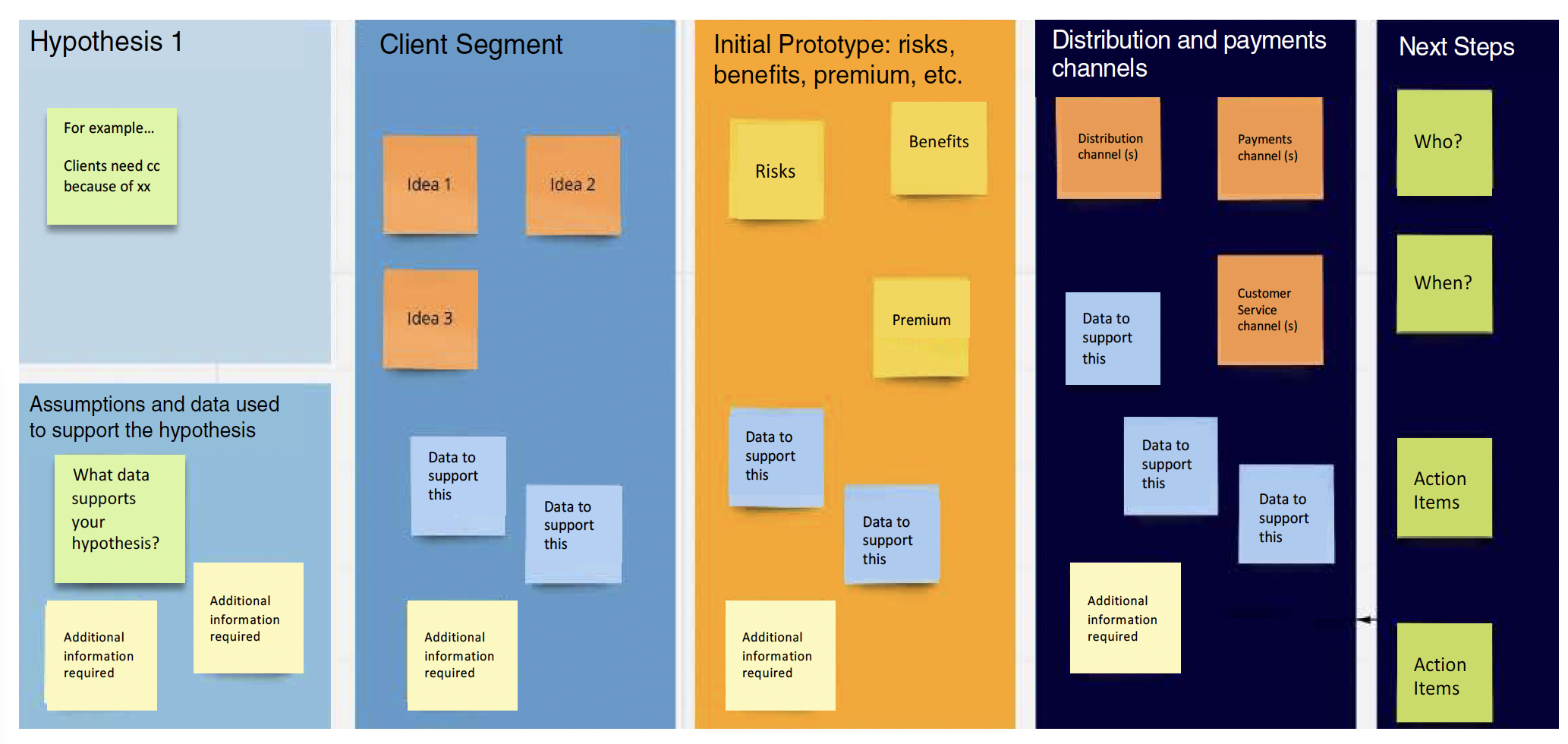
Figure 3.1 shows how a Miro board can be set up for thinking about a hypothesis for a specific client segment: for example, rural market vendors cannot lose income during severe climate events and would benefit from insurance coverage. The board considers the assumptions included in this hypothesis (for example, that market vendors cannot transport materials during severe events), the characteristics of the client segment and the type of cover that may be useful to support this client. It also considers the distribution and payments channels to be used, and it can be set up to consider concrete actions and next steps.
The example in figure 3.1 can be used as a Miro board or else adapted to in-person brainstorming. Remember to question your assumptions and use data to justify your thinking as much as possible if you want to prototype with clients at the centre.
3.2. Distribution channels
You have already gathered a lot of information about the way clients think about different distribution channels, how frequently they use them and how much or little they trust them. Frequency and trust are very important in considering the role of a distribution channel. Today, many insurers are integrating digital tools into some aspect of back-end or front-end distribution. But since many target markets may not be comfortable with fully digital processes, it can be useful to think about distribution more broadly, as a multichannel process that reaches some target clients digitally and others with a more human touch.
If you are an insurer, consider what you need from your distribution channel before you open partnership discussions. You can rely on your distribution channel for all or part of the work along the customer’s journey. Box 3.3 provides a checklist that your working group can discuss to identify your partnership needs. But remember, it is a partnership: you are not outsourcing the work, you are collaborating towards a joint outcome. Partners need simple, useful and attractively priced products. They need training to understand how the product works and how to make claims when needed. They need excellent customer support to ensure that their clients are not disappointed. And they need a smooth and simple claims process. Sometimes, partners need special sales training that can teach them how to offer insurance responsibly and not mis-sell (see section 3). If an insurer can provide all this, distribution partners will be excited to collaborate with them.
Once you have identified what you are looking for in a partner, make sure that the partner has sufficient capacity. For example, if you need a retail partner’s cashiers to explain insurance to customers at the cash register, make sure that the existing business model allows for cashiers to be trained, and then take the time to do this.
It is very important in this part of the process to define an attractive incentive scheme for these front-line workers. Some partners will engage insurers actively and even pay the front-line sales force directly with commissions from insurers. Others will prefer to manage their own incentives and collect a general amount of commission to divide up among staff. Be aware of how different schemes might influence the incentives of front-line workers. If they are rushed, can they explain a product well? If incentives are very high, how will you manage the risk of mis-selling?
You should also be aware that without regular and sufficient training, partners may not explain your product well to customers. To be client-centric, front-line staff need to understand the product and communicate effectively about it. Training should be conducted before rolling out products, but it also needs to be frequently refreshed, since staff turnover is common. Technology can help reduce the cost of these refreshers by allowing for text, web-based and video modules to explain and reinforce front-line staff’s understanding of concepts.
Checklist for preparing a conversation with a distribution partner
Fill out this checklist in advance of discussions to help guide your negotiations. Make sure expectations are clear from the start. As you consider each point, think about whether this distribution channel is a convenient and trusted source for customers in accessing these services. Ultimately, your aim is to get closer to the customer to improve their experience.
Awareness
Do you need the distribution channel to educate customers about your product and how to use it? Will this be done with above the line marketing (traditional advertising) or using below the line resources that engage directly with clients on the ground? Can the distribution partner help design marketing materials that are attractive to customers and easy to understand?
Acquisition and enrolment
Will the distribution channel be enrolling customers onto your product and if so, will it use its own forms and technology, yours, or a combination of both? Are there any regulatory constraints that impact its role in this process?
Payments
Will the distribution channel collect premium payments on your behalf? Will these be grouped or paid individually by clients? Consider the cost of these transactions and the benefits of using one or multiple partners to collect payments.
Servicing and post-sales support
Does the distribution channel have the capacity, either through branches, call centres or field staff, to answer questions about your insurance product or solve issues that arise when clients lose policies or need to change beneficiaries?
Claims management
Managing claims is part of post-sales support, and it is a very important part of ensuring that clients receive value from the product. Can the distribution channel facilitate this process by collecting information from clients and their families when they make a claim? Can it help gather required documentation?
Leveraging distribution partnerships to benefit partners and customers – Turaco in Kenya
“[Partnerships] are incredibly powerful … But it is a relationship that takes investment and communication and … a shared vision for what we’re trying to build together” – Rachel Levenson, Chief Commercial Officer, Turaco.
Turaco provides affordable insurance solutions to underserved populations in Ghana, Kenya, Nigeria and Uganda, integrating with fintechs and financial institutions to deliver mass-market products digitally.
In Kenya, financial constraints combined with a lack of trust in insurance hold back insurance purchases. Turaco identified the need to align insurance offerings with customers’ existing financial relationships to better reach customers and ensure smoother processes.
Turaco partnered with a large pay-as-you-go (PAYGO) financing company to embed insurance into customers’ existing financial transactions. Low-cost hospitalization coverage was bundled with financed cell phones.
For Turaco, this meant being able to leverage the partner’s brand trust and payment systems, making insurance more accessible for customers. For its PAYGO partner, bundled insurance served as a differentiator in a competitive market, while mitigating credit risk by protecting customers from financial shocks. Insured customers were 60 percent less likely to default on their loans.
Customer feedback highlighted the value of embedded insurance, and many clients opted for additional coverage after their initial exposure. This helped convince the PAYGO financing company to continue to partner with Turaco and improve product design and processes. Meanwhile, Turaco was able to scale a small product to achieve sufficient volumes for profitability and risk reduction.
A key element of Turaco’s strategy is making sure people at all levels of their partner organization understand the insurance and know how to talk about it. This requires continuous engagement and training, including back-office staff as well as field staff. Levenson says: “every single person at the company needs to understand the insurance.”
3.3. Pricing your product
Pricing is an iterative process and should be considered as part of the product development process, rather than as the start or end point. When iterating product design, getting the price right is important, since clients’ resources are limited and even a very relevant cover may not be useful to a client if it is not affordable. Actuaries can be useful in helping you to determine some initial pricing estimates. You can then test these estimates with target clients in a prototype testing activity, and adjust and finalize them as the product coverage and benefits are refined.
Inclusive insurance products require a new approach to pricing, because data may not be available, and even if they are available, data may not be accurate. Traditional actuarial tables may not include the type of client that inclusive insurance aims to serve. In some cases, these clients may have lower risks than the general population (for example, if they belong to a distribution partner that only covers healthy young workers); in other cases, they may have higher risks, for example, if they live in precarious conditions.
Expert tips on pricing inclusive insurance
In Actuaries in Microinsurance: Managing Risks for the Underserved, J. Blacker and M. Yang recommend some guidelines
- Identify evidence-based financial risks
- Pool risks through scale, diversification and appropriate reserving
- Stress-test various pricing scenarios
- Reduce costs that you can control, such as operations, by reducing inefficiencies and leaning on partnerships for distribution
- Build rigorous actuarial models.

Experience pricing can be a useful tool in setting prices. This model allows insurers to use real data from past experiences to make assumptions about future claims. It requires a relatively large longitudinal sample, which may be available for some risks. The great advantage of this method is that it helps you leverage existing internal information without requiring large external data sets on populations that may not be well studied. For example, microfinance institutions may track their own client mortality rates to assess client risk. They can share this information, and actuaries can use it to extrapolate future mortality risk. For some risks, it is important to stress test varying scenarios and have clear assumptions to ensure that they can be monitored appropriately. For example, if an MFI portfolio is primarily composed of urban merchants, but has plans to expand to older, rural farmers, mortality probabilities might change.
Exposure pricing, on the other hand, uses external data, often leveraging non-traditional data sets. It can be most useful when considering new, innovative product covers, where experience is limited. Exposure pricing makes assumptions about the frequency and severity of claims. When data are not available, actuaries can use alternative sources of information to complement their models. For example, climate risks can be estimated by reviewing records in local government agricultural departments and/or asking clients directly about their own recent experiences and damage. Similarly, fires in public markets are usually documented by local radio stations or newspapers. And extensive bodies of research exist on low-income communities, some of which offer data on financial shocks in local communities. By working with partners and collecting data from clients, national surveys and third-party sources, insurance companies can build sufficiently robust models.
Credibility pricing combines both methods, when they are available, to ensure a more credible scenario. It assigns relative weights to each method, allowing actuaries to leverage the most available information. This can be especially useful when submitting new products to regulators who might require a robust explanation of pricing in approving new products.
Administrative expenses for inclusive insurance products can differ significantly from traditional insurance, depending on the value chain. For example:
- Embedded insurance products may have lower operational expenses but higher marketing costs
- Agriculture insurance schemes, such as area-yield products, often incur high administrative expenses due to claims administration costs.
Instead of applying a standard administrative expense loading, companies should analyse the value chain to determine a more accurate representation of these costs.
Distribution expenses are typically regulated through caps on commissions paid to intermediaries. However, the role of distribution partners can vary significantly, encompassing awareness creation, enrolment, servicing and claims management. These roles should guide the allocation of distribution expenses.
In some regions, regulators permit additional costs for platform or technology providers, such as insurtechs. These expenses can also be incorporated into product pricing in accordance with regulatory guidelines.
3.4. Prototype testing
Prototype testing takes us back to the principles of collecting new data and can happen in focus groups or surveys. When you are testing prototypes, create presentable, easy-to-read materials to show clients the product prototypes. These should mimic the marketing materials, language and sales speech that you would use if your product had already been defined. This way, you will obtain the most realistic feedback possible and can test out your draft marketing materials, language and training for front-line staff at the same time as you test out your product.
When showing clients a new product, make sure that you develop an instrument for surveys and focus groups that allows clients to explain what they like and dislike about each product. If you have a few options, it would be very useful to ask clients to rank the products in order of preference. Remember to ask clients to provide their gender, age, occupation and any other characteristics by which you will segment them, so that you can later see if one particular segment preferred one product to another.
Since you will be speaking to clients about very concrete products, work with your actuary and define some approximate premiums for each one. This way, when clients give you their opinions about the product, they are also providing their opinions about the product’s affordability. You can test hypothetical pricing. When your clients state their product rankings, ask whether they would pay a premium 100 percent higher than the one you estimate. If they say no, ask whether they would pay a lower price. Keep reducing the price, thereby learning their price sensitivity threshold. If you reach your estimated premium and they are not interested in paying for the product at that price, ask what features, if any, would make the product worth that price, or whether any features could be eliminated to make the product more affordable.
A more ethically dubious method, but one that some insurers do use, is selling the client a prototyped product (for example an MVP, or minimum viable product), which is not yet available in the market and may not be ready to be serviced, at a set premium in order to find out whether potential clients will buy it through the planned distribution channel. In this case, when clients agree to buy it, they are told that they will be officially enrolled in a few weeks, and their responses are tracked in a survey instrument with some elements that mimic an enrolment form. The clients’ information is captured so that they can be contacted with updates on the product’s development.
Be aware of the ethical issues with selling customers products that do not yet exist, and if you decide even so to take this approach, do not take any payment from the customer. When the exercise is complete, explain to the customer that the product has changed and offer a different product if they are interested.

Designing and prototyping products – Pioneer Life in the Philippines
Pioneer Life’s innovative ER Care product covers clients when they go to the emergency room. It is cashless (subject to coverage limits) and enables clients to avail of emergency care from a hospital or clinic.
The product was born out of conversations between Pioneer and their customers during field visits. In one such conversation, Pioneer Inc. CEO Lorenzo Chan and his colleagues were visiting a customer in his home and found around 10 more visitors than expected waiting to receive them. Chan decided to turn this visit into an informal interactive townhall and asked the visitors if they have needs with which an insurer could help them. Some shared that when they go to the emergency room (ER), the hospital requires a deposit. Being unable to pay means no access to urgent medical services.
Chan found the insight interesting, but says that “two or three anecdotes do not make a concept”. He went back to Pioneer’s microfinance partner to validate the exchanges, and then organized a few focus group discussions with clients. These provided confirmation that there was a need for cashless emergency care in that market segment.
Pioneer found a partner with access to a network of clinics and hospitals that was accessible to the market. They designed a product prototype and ran it past more potential clients. One salient input was to include maternity care as an emergency benefit, since women faced the same issue when they arrived at the hospital for delivery. Pioneer went back to the drawing board and included a small coverage for maternity.
Designing the product required multiple iterations of talking to clients, going back to the drawing board and adjusting the product. It also required a very clear idea of the type of partnership that would be critical to ensuring the client’s needs were met. After a pilot test in 2019, the product launch was interrupted in 2020 as a result of the COVID-19 pandemic. The product was relaunched in April 2021, and by 2022, Pioneer had sold 11,600 policies with a total premium value of $440,000.

3.5. Final product development
After prototype testing, your team will assess the results of your testing and go through some iterations with your actuarial and product teams. This step can include a second design workshop in which the same participants take the feedback from testing and refine the designs. This is also a good time for actuarial consultation, if you have not already done this.
You may want to use tools such as the RICE Scoring prioritization model, which scores products by Reach, Impact, Confidence and Effort (RICE). This can help determine which products are most viable in terms of opportunity, risk and resources needed. The ILO’s PACE model can help you think through the I in RICE (Impact) by understanding more holistically the value of the product to customers across four dimensions: Product, Access, Cost and Experience (PACE).
This development part of the process requires a lot of discipline to ensure that products are simple as well as easy to understand and use. Be aware that having to explain complicated exclusions, waiting times and deductibles to clients adds to distribution costs and the risk of mis-selling. It will also reduce the likelihood that clients understand the product, and thus they might value it less than you anticipate. Moreover, inclusive insurance products tend to have short terms, between one day and one year, and as such, waiting periods may make little sense.
Making a product tangible is always a challenge in inclusive insurance, particularly if the product covers unlikely, catastrophic events. Value-added services such as telemedicine, pharmacy discounts and vehicle support may be very attractive to customers, as they are tangible and can be used even when a policyholder does not suffer a catastrophic event covered by insurance.
Remember that some extra features may increase the price but not add value or tangibility, since they will most likely go unused. While some value-added services are very useful, others are designed for higher-income customers and may not meet the needs of your clients. Review evidence of usage of value-added services in other inclusive markets before you consider them. If this evidence is not available, analyse the usage of value-added services in traditional markets. If it is already low in those markets, it will likely be lower in inclusive markets where clients may have less time or be less comfortable using remote services.

Testing product prototypes with clients – AXA Mandiri, Indonesia
AXA Mandiri’s research in Indonesia (see case study 2.2) led to the development and testing of various products based on the external data collection exercise and design thinking workshops. These cards were then used to test prototypes with sample clients.

Checklist: Product and process design
Did the team…