



Manager’s brief
It can be very tempting to stop the client-centric process once you design a product, but instead of an ending, think of it as a beginning: the beginning of your new client-centric approach to ensuring that you have created a valuable product and process that is inclusive of even the most vulnerable. As marketing expert Philip Kotler says, “Marketing is not the art of finding clever ways to dispose of what you make. It is the art of creating customer value.”
This section emphasizes the importance of using the information you have gathered about the client to design an effective marketing strategy that strengthens the process of value creation. A strategy should address who, what, where and how you will reach out to potential clients and transform them into new and recurring clients.
Many operators assign all the marketing and communications of their inclusive insurance products to an internal marketing or communications department within their institution. This has some risks when working on inclusive insurance. First, marketing your product depends very much on what you are marketing and on whether your product is appropriately designed for your target customer and segment. The process begins there; this client-centric design can be then incorporated into a strategy to offer the product. Consider also that the skills and capacity of different external stakeholders may not be sufficient to completely outsource this role.
If your business’s usual target customer is in a low-income or vulnerable segment, you may be very experienced in how to communicate with the customer but not in how to explain insurance products and their technical characteristics. Alternatively, if you are specialized in insurance, you may be experienced in offering explanations about insurance, but less familiar with how to communicate in simple and transparent language that is easily understood by the target segment. This is why market research can be especially helpful when you plan a marketing strategy for an inclusive insurance product. It can tell you more about the clients you are targeting, the risks they worry about, their expectations when buying a product, how they learn about the product and which channels they trust most.
Market research can also tell you about clients’ income and ability to pay, as well as the most accessible payment methods for them. Your target clients may also have insights into the claims process and how benefits should be paid out. If your market research involved distribution channel front-line staff, such as loan officers at an MFI, government workers, mobile money agents or programme staff at a non-profit organization, they will have given you some important insights into how they work and what motivates them. This will help you identify appropriate partners, design effective incentive systems and customize training programmes.
Clients who buy insurance should know what they are buying, understand how to use it and value it. Otherwise, you will just be taking clients’ money without offering value in return. This is why proving clear marketing messages and tracking performance are essential in inclusive insurance.
If you completed section 1 and section 2 of this Navigator, you already have most of the elements of a successful marketing strategy. Through this process, you have likely defined your target market, as well as your product and its value to that market. You have come up with some ideas about distribution partners and you have some sense of the language that clients use to understand your insurance product. You will likely have discovered many other interesting insights about your existing and potential clients. For example, are they easy to reach by phone, in groups or individually? How easy is it for them to understand the concept of insurance? Who do they trust most to explain or offer this product? All this information will help you design your marketing strategy.
Once you have defined your strategy, you can consider the cost and whether it is affordable. Marketing a small premium to many customers requires strategies that are different from marketing a large premium to a few customers. Above the line strategies such as billboard advertisements, radio and TV can be extremely expensive. Consider instead using local radio stations, or social media and influencers. Technology can be useful in promoting your product as well, but remember, your segment may have less understanding of insurance and lower trust in technology, so analyse any digital plans carefully to see if they work. Below the line strategies that deploy variable costs, such as face-to-face agents, may be more effective on a per unit basis in reaching and building trust with your end clients.

Below the line marketing example
Many insurers in Colombia use their own call centres to reach potential customers with new insurance offers. They partner with utility companies, for example, which provide lists of clients that insurers can call to promote products and enrol new customers. Premiums are then deducted from utility bills. Some utility companies even have their own call centres dedicated to this function and earn commissions from sales.
As box 4.2 describes, your strategy should address who, what, where and how you will reach out to potential clients and transform them into new and recurring clients. The tips in box 4.2 can help you think about how you can use your research findings to address each of these issues.
Considerations in your marketing strategy
Consider these elements of your marketing strategy as you plan to take your product to market. A strategy is not just a set of materials or an incentive scheme. It should be a plan that identifies targets and how they will be achieved, and assigns responsibilities, resources and deadlines to the process.
table 4.1. The elements of a marketing strategy
| Who | Market sizing. How many customers do you want to reach in the short, medium and long terms? |
| Client segments. Which specific segments will you target? | |
| What | Competition. What value-add will your products offer versus the competition? Remember that in informal or underserved markets, the “competition” might be the informal strategies that clients currently use to manage risk rather than a formal financial product. |
| Value proposition. What is the value proposition of the product and pro- cess vis-à-vis what clients have access to already? | |
| Where | Distribution. Who will enrol clients? Who will take premium payments? Who will offer post-sales customer support? Who will process and pay claims? |
| How | Communication. Who will make clients aware of a product? How will you train them? What points of contact are most effective in your segment: face-to-face, billboards, phone, social media, web or a com- bination of many types? |
| Marketing. What materials, training and incentives are needed to sup- port the product distribution? | |
| Budgeting and planning. Who will be responsible for each action item in the marketing strategy? How will these responsibilities be embed- ded in partnership agreements, commissions and other incentives? When are key milestones for the project? How much will this cost? |
4.1. To whom are you selling?
A marketing strategy begins with defining your target market by assessing the market size and defining the client segments you want to reach. Your internal and external data collection exercise should have provided you with an idea of which market segments you are targeting and the approximate size of these segments in your target geographic area. You might develop some personas (such as Eduardo and Erica) to bring these clients to life and imagine how they will interact with your products. Box 4.3 gives a detailed example of a health shock suffered by Eduardo and Erica and how the family handles it. This can help you consider all of the elements to keep in mind in defining a client-centric marketing strategy.
A client-centred marketing strategy

When Eduardo became sick with malaria in 2019, he was ill with high fever symptoms and weakness and was unable to work for over two weeks. Eduardo’s wife, Erica, could not manage his shop because of the very rigid schedule she had at the factory. Moreover, Erica relied on Eduardo to bring her to work in the morning, which he was unable to do.
Luckily, Eduardo was able to get help from his sister, who watched the shop. His mother watched his sister’s children while his sister worked in the shop. After work, Erica checked in on the shop and made sure all the accounts were in order.
Everyone worked together to help out, but one problem was that Erica had to pay extra for a mototaxi to take her to work every morning. This represented a big part of her monthly income. Additionally, she had to pay for medicine for Eduardo’s illness.
To deal with the financial impact on the household, the couple did a few things:
- Reduced their food expenses for the month
- Obtained a small loan from a neighbour to cover the cost of Eduardo’s medication and other expenses
- Saved money on gas from Eduardo not driving his vehicle.
When you are marketing to people like Eduardo and Erica, remember to emphasize the value of the product to them. The product could help them avoid borrowing from friends and family and cover Erica’s additional expenses (transportation) until Eduardo can go back to work. The couple would likely not respond to the message of the product as a way to protect Eduardo, since he has managed much of his risk.
4.2. Defining your “what”: The value proposition
Consider the value proposition of your product for these clients and how the product might be different from what the clients can already access. When thinking about your value proposition, it is not enough to consider whether your target market has access to similar insurance coverage; you must also consider the informal ways in which they already manage their risks.
Think about the case of Eduardo, and how he manages the risk of falling ill in box 4.3. What would be the value proposition of a malaria insurance cover for Eduardo? The product might appeal to him if it covers the cost of medicine and household expenses, such as Erica’s transportation. If the product was marketed as one that would help cover business losses, Eduardo might think “my sister can watch the shop, I don’t need the insurance.”

Improving the value proposition – VisionFund Ecuador
“By integrating affordable health solutions with value-added services such as ambulance support and medical brigades, we not only improve the well-being of communities but also foster trust and sustainability” – Nataly Galán, Regional Insurance Manager for Latin America and the Caribbean, VisionFund International.
In Ecuador, VisionFund recognized enhanced health solutions were needed to fill gaps in the national health insurance system, especially for vulnerable communities for whom transportation and out-of-pocket costs were significant barriers to healthcare access.
It introduced Seguro Familia Protegida (Family Protection Insurance), an embedded opt-out insurance product priced at just $1.15 per month. The product provides telemedicine coverage, including reimbursement for medical expenses and accident coverage.
However, telemedicine is a new concept in Ecuador, and after the initial roll-out, low claims on telemedicine suggested new approaches were needed to bridge remote health services with clients’ needs for in-person provider contact.
VisionFund partnered with World Vision Ecuador to introduce Ambulancia Naranja (Orange Ambulance), a dedicated ambulance service, and medical brigades offering direct health support. These additional services enhanced the product’s coverage, increased accessibility, promoted preventative health and extended outreach to both clients and non-clients. The services were particularly impactful in providing essential health assistance during climate emergencies.
Since October 2022, the Ambulancia Naranja and medical brigades have served more than 14,000 people, with a 97 percent satisfaction rate. Notably, 78 percent of beneficiaries were non-clients. Approximately 30 percent of these non-clients transitioned into becoming VisionFund clients after benefiting from Ambulancia Naranja and medical brigade services.
Learn more about Ambulancia Naranja here.
4.3. Where will you offer the product? Identifying distribution and partnerships
In the example of malaria insurance for Eduardo, an ideal distribution partner for an insurance company might be the pharmacy. Ideally, a distribution partner has a financial relationship and a relationship of trust with the end customer. This helps both provide a trusted acquisition process and a payment channel. Learning about who clients trust is an important part of market research, as some will be more trusted than others, such as in the case of Erica in box 4.4.
Identifying the right distribution partners in the Philippines

When interviewing Erica and her colleagues in a series of focus groups, we discovered that Erica trusts her company and her manager. Many of the workers eat together with their managers during lunch and have picnics with their colleagues on special holidays. Their managers have connected them with a bank that receives their salary, and this bank has offered them loans that allow them to buy vehicles and even homes. Erica used one such loan to purchase Eduardo’s motorbike, and she trusts the bank because her manager connected her with it. This experience is important in considering a potential delivery channel for insurance both to Erica and to Eduardo. As Eduardo works informally, there are fewer ways to reach him, and Erica’s work might be a useful channel.
However, the lessons we learned from interviewing Erica and her colleagues are not applicable to all situations. In another series of focus groups, we heard that a different factory has gained much less trust from its workers. In fact, there have been some uncomfortable situations in the factory, in which some women were given longer breaks and more leniency because they smiled at a manager more and “acted friendly”. This bothers the workers a lot. They feel vulnerable and prefer to keep their lives as private as possible so as not to create any conflict at work. When trust in the employer is low, it is less likely that staff will trust the institutions with which the employer works.
When you identify a suitable distribution partner, consider the following:
Does this partner work with the target market I have identified?
Ask the distribution channel for internal data on their clients or hold some bottom-up segmentation focus groups with front-line staff to verify that you are, indeed, targeting the same population. Remember that “the poor”, “the vulnerable” or “bottom of the pyramid” are not one single segment. There may be multiple segments in these broad categories.
Are our incentives aligned?
Incentives are not everything, but they are critical. You might have a great product, but if your distribution channel does not offer the product to clients or does not spend time highlighting and explaining it, the product will not get to your end customer. If you are partnering with a brick-and-mortar business, when you interview front-line staff, ask them what motivates them. Make sure you offer ideas that are not only financial. See section 4.5 for a discussion of sales incentives.
Consider different types of incentives for different distribution channels. For example, fintech or insurtech distributors may not ask for a commission, but instead, might use your insurance product to incentivize client behaviours. Case study 2.11 explains how insurance was used to incentivize acquisition by women of a credit card reader, for example. This case emphasizes the importance of tracking performance by sex to understand the gender implications of different strategies.
Using insurance to incentivize fintech adoption – Noahui Soluciones in Mexico
Noahui Soluciones, a platform that onboards low-income merchants to fintech products, partnered with KiWi, a fintech providing low-cost pay-as-you-go credit card readers, to test the impact of adding free life insurance to each KiWi terminal to incentivize client acquisition and usage. After a pilot test, they learned that 5.8 percent of women purchased KiWi terminals when they were offered free insurance vs. 2.8 percent of men. This was a good opportunity to expand KiWi’s reach to a new client segment: women, who typically purchased fewer KiWi terminals than men.
Source: Noahui Soluciones, México.
What role will the partner have along the delivery spectrum?
Distribution channels can take on different roles. One mistake that insurance companies might make in partnering with a distribution channel is assuming that the partner can be useful across the whole delivery spectrum (figure 4.1). Each actor should focus on their core competencies. To ensure this happens, it is important to discuss what these core competencies are when sitting down with distribution channels and insurers and identifying the relative roles and responsibilities in detail.
You can see from the delivery spectrum in figure 4.1 that finding a partner that can do all of the tasks in the spectrum is not easy. For example, trusted sources of support might be very useful for awareness-building, education and acquisition but may not have the technical interface to cover enrolment.

Plugging multiple partners into one insurance platform – Democrance in the United Arab Emirates
The product: Personal accident insurance for remittance senders
Description: Accidental death and accidental permanent total dismemberment
Sum assured: ~$11,000
Term: 1 month
Volume: 104,479 policies.
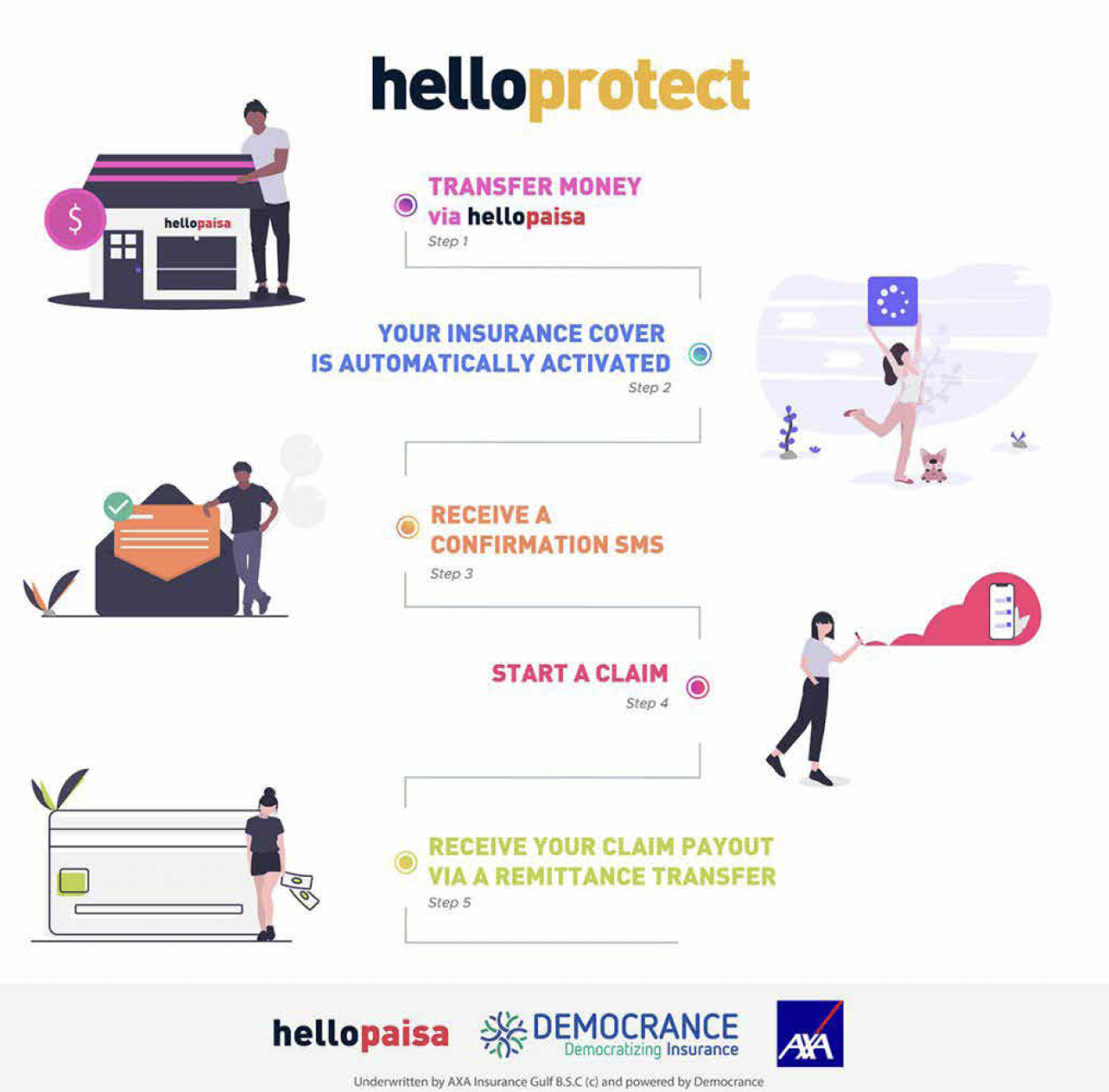
Democrance is a business to business (B2B) data-enabled, white-label, software as a service (SaaS) plug-and-play technology platform that digitizes sales and distribution verticals of the insurance value chain for emerging market segments. It allows insurance companies to leverage existing distribution channels that are not set up to offer insurance.
For example, in the United Arab Emirates, the company partnered with AXA Insurance and Hello Paisa, a remittance operator, to facilitate the addition of a free insurance product to Hello Paisa remittance transactions with minimal IT integration. This offers value to Hello Paisa customers, gives the company a competitive advantage in a crowded market, and helps AXA Insurance with the acquisition, enrolment and payment collection pieces of the delivery spectrum. AXA is able to handle claims through the Democrance platform as well, covering the final two parts of the spectrum. The only gap in the delivery spectrum exists in awareness and education; Hello Paisa may be trusted by its customers but may not have the right incentives in place to educate clients.
How will we monitor success?
In section 5.1, we discuss servicing your inclusive insurance product and how to measure success. Consider both social and financial goals and assign indicators to the appropriate partners. For example, if you are measuring claims, insurance companies may be best prepared for this. If you are measuring poverty indicators, a distribution channel may be closer to the customer and may have more data or better capacity to collect data for the product.
4.4. How to effectively communicate with clients
Whether you conducted full market research, limited market research or some prototype testing, you have learned something from your clients about their impressions of your product. These insights are very important because they reflect the understanding and perceptions of clients in their own words. When clients hear explanations of your products in their own words with their priorities and needs in mind, they will be more open to understanding the products and they will see more value in them. Often, a clear and transparent marketing flyer or speech can have a much greater impact on building client awareness and education than a long education session – and it can be more cost-effective as well.
Box 4.5 contains some tips you can use when you analyse the results of your client conversations to develop marketing messages and materials. If you can, test your draft materials with a small sample of clients to make sure that you have identified the most relevant images, explanations and language.
Tips for using market research to develop education and communications materials
Listening to customers has huge benefits in developing marketing and education materials. Clients can tell you the risks that they worry about and the aspects of a product that they like the most or understand the least, which can help you focus your materials so that they are as simple and relevant as possible.
Language: If you have listened carefully, you may discover the best name for your product from listening to clients. For example, at one insurance intermediary in East Africa, researchers discovered that explaining a “hospital cash” product as “sleep in the hospital cash” was a clearer way to explain that coverage only began if the insured person spent the night in the hospital.
Personal characteristics: If you decide to use animated characters or photos of clients, you should look at the people you interview and try to demonstrate to them through visual aids that the product is meant for them. Some insurers aim for “aspirational” photos that show middle-class houses. While this might be appropriate to your market, it can also signal to some clients that the product is not for them. Instead, consider aspects of the people you interviewed. You do not want to show anyone in messy work clothes, which could be offensive, but you want to show and celebrate what the target clients really look like.
Main product characteristics: Through your qualitative research, or perhaps through your work prototyping products, your team should also have identified the main points that clients will find attractive in the product, including whether the premium is affordable. They may also find the product very relevant in terms of coverage because they are very aware of the financial cost of a covered event. Another point clients may have noticed is the amount of the benefit or that it is the right size for their needs. Or maybe the ease with which they can enrol appeals to them. Listen carefully and make sure these qualities are included in your marketing materials, sales pitches and messaging. Keep your main points short, though, or they will be hard for clients and front-line staff to remember!
Other issues to consider: Perhaps in your discussions with potential clients, you identified the brands they trust most. In your materials, consider using similar styles and colours to those used by clients’ trusted brands. Or maybe you have found that the locations where they can make a claim are important to them. This would suggest highlighting the locations with a map or photos.
You may find that different market segments or people from different regions use different cultural references or even languages. This may require adapting the materials to suit these differences. Using populations from the target market in your materials can help your marketing team adapt to these differences easily. The most important thing is to listen carefully to all your target clients and reflect on anything you learn that can help them better understand the product.
4.5. Distribution: How to train and motivate a sales force
4.5.1. Who will be trained?
Before you consider ways to train and motivate a sales force, you need to figure out whom you need to train. For example, if you are working with a microfinance distribution channel, loan officers may be tasked with offering the product, but cashiers who are taking loan payments also need to understand why there is a monthly charge in their customers’ loan payment receipt. Often, cashiers need to resell the insurance product because clients have forgotten they have coverage and complain about a bill.
If you are working through a multichannel delivery process, consider also call centre staff, social media managers and senior managers who control performance evaluations and commissions for staff. Even the security guard at the door should be aware of the product in case anyone walks in and asks for insurance. You do not want a guard to say, “no, we only offer money transfers here, not insurance” just because they have not been informed otherwise.
4.5.2. How will you train?
Once you have decided who will be trained, consider how you will train your delivery channel. Begin by understanding your partner and how it currently trains its front-line staff and management. You will want to use or adapt existing methods that are familiar to staff. As well as easing the learning burden on staff, this can help operationally, if you are working with a complex organization or in a wide geography, by making training easier to implement.
You may want to use digital tools, in-person training or both. If you or your partner already conduct in-person training, you might consider adding more sessions to cover insurance distribution. Remote training can be convenient and much more cost-effective; however, it can in some instances be less effective in achieving learning outcomes. Remote tools can be used alongside hands-on activities to ensure that learning remains active.
Keep in mind that staff often rotate, and so you will need a plan for refreshing training on an ongoing basis. Online and SMS delivery will likely be the most cost-effective for refreshers. It is very important that training be conducted by experts who understand the product, but also understand the customer and how they learn. A team of trainers or multiple sessions may be most effective. Regardless of how you train, it is very important to include simulations in the training so that front-line staff can practise and gain confidence with the material before speaking with clients.
4.5.3. What will you train on?
Training front-line staff can be daunting. Often, we are training people who themselves do not understand or value insurance, which makes it difficult to transform them into inclusive insurance advocates. The easiest way to help them learn to understand and value insurance is to have them try the product themselves by giving them discounts or free insurance to test. When this is not possible, or if the product is not very tangible because it covers only catastrophic events (such as life or property insurance), you can still find ways to get your sales force excited about selling your product. Many resources are available online to develop insurance sales training. Box 4.6 offers some useful tips on how to design a training curriculum.
Hands-on exercises should be a part of the training, since even when they understand how a product works, front-line staff may be uncomfortable selling insurance when it is not their main activity. They might worry their relationship with the client will be damaged if the client does not like or trust the product, or they might feel concerned that a client may ask questions they cannot answer. As a result, it is important to practice selling through simulations among peers, and if possible, using fieldwork with a select group of clients under supervision to test out staff members’ confidence and assuredness in selling.
You should keep in mind that your clients may have low awareness and trust in insurance, so there will be an important component of education in your sales strategy. Part of this will come from your sales staff, who should offer a transparent and clear explanation of the product, using the most relevant materials. Another part will come from your clients’ and their community’s experience with the product. Paying claims easily, promptly and effectively shows that you are keeping your promise and that you can be trusted.
Your training programme
When designing a curriculum, keep in mind some important concepts that should be covered:
Operational issues
- How materials will be distributed
- How enrolment paperwork and/or technology works
- How payment processes work
- How claims processes work
- How staff will be compensated for sales (if relevant)
- Who can answer questions
- Data tracking protocols.
Commercial issues
- The covered event and why it is relevant to your client (for example, “climate change is affecting your crop cycles”)
- The financial needs of clients when they face such events (for example, “when clients suffer a loss in yield, they have less money to reinvest in their next cycle”)
- How the insurance product addresses these problems (for example, “this product pays clients $200 if their production losses are over 50 percent of estimates”)
- How the insurance product is paid (for example, “clients can pay for this with their loans”)
- How claims are made (for example, “clients can call their loan officers to make a claim if they suffer a loss of over 50 percent”)
- Where clients can turn for more information (for example “clients should call this number when they have questions”).
4.5.4. Commissions and other incentives
Even if they are fully dedicated to your product, most sales representatives will expect a commission for selling insurance, especially if a product is not bundled with a loan or a free service but is a voluntary or stand-alone product. The problem is that commissions on inclusive insurance tend to be quite low because premiums are low in order to make products affordable. This is where some creativity is needed to incentivize sales.
Consider some “carrots and sticks” to motivate sales. Some “carrots” you might offer could be points that can be traded in for prizes or activities and events. Recognition might also be an incentive: offices with high sales could be celebrated throughout the company and invited to a special meal. You could also consider introducing short-term, competition-based incentives during specific stages of the product cycle. For instance, additional incentives (cash or otherwise) could be offered for a limited period during the launch or re-launch of a new or modified product. This approach can help drive engagement and boost initial performance.
You might also consider “sticks”. Some microfinance institutions set insurance targets that trigger additional benefits when loan sales targets are met, for example. However, if targets are not met, loan officers forgo some component of their commission on loans.
Regardless of whether you use carrots, sticks or both, it is essential to balance the need to meet sales targets with consumer protection. Clients who buy insurance should know what they are buying, understand how to use it and value it. Otherwise, you are taking clients’ money without offering value in return. This is why, in inclusive insurance, it is very important to provide clear marketing messages and track performance.

Incentivizing voluntary renewals – Compartamos Banco in Mexico
In 2012, the Microinsurance Learning and Knowledge (MILK) project studied the demand for an inclusive life insurance product and learned that voluntary renewals could be promoted through the use of initial subsidies, as well as standardized sales training and messaging about the product.
The life insurance product was offered to over 1.8 million clients of Compartamos Banco in Mexico. Compartamos subsidized coverage by providing one free module (with a $1,160 benefit) to each of its village bank borrowers. At their own cost, borrowers had the option to purchase up to seven additional modules.
The study involved a randomized control trial (RCT) that tested the impact of eliminating the free module of insurance on clients’ purchase decisions and total insurance coverage. The results showed that those clients in groups with no subsidized coverage were 5.2 percentage points more likely to purchase insurance (one or more modules) and purchased 0.15 more modules on average. This suggested that the use of subsidies may have contributed to increasing client trust and perception of value of insurance, so that when they were faced with losing the product, they voluntarily purchased it.
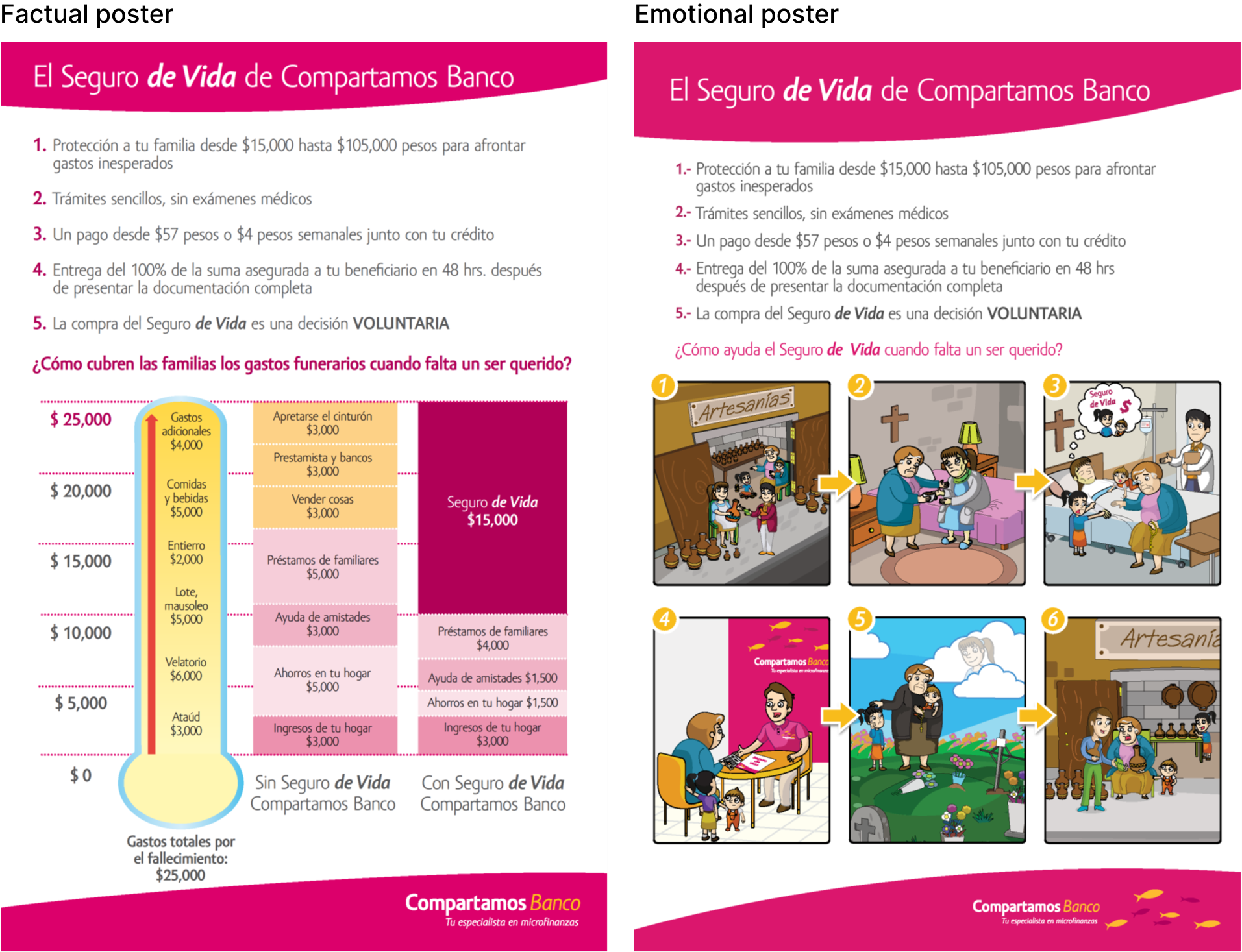
The study also analysed the use of two standardized marketing interventions to offer these additional modules across the Bank. The marketing interventions standardized the information provided to borrowers by introducing two posters that loan officers brought to group meetings. Loan officers were trained to follow the script precisely and use the posters as visual aids.
The top half of the posters provided the same basic information about the product. In the bottom half of the first version, a “factual” poster emphasized the financial toll that a funeral takes on a family and how insurance benefits can compensate for some of these financial costs. The second version was an “emotional” poster, which used a series of pictures to tell the emotional story of a family saddened by the death of a breadwinner and how insurance helped them to recover. Half of the groups were presented with the factual poster; the other half were presented with the emotional poster.
The study found strong suggestive evidence that the standardized marketing approach, regardless of whether factual or emotional, increased sales of insurance. The percentage of clients who purchased any insurance increased by more than 20 percent after the standardized approach was adopted. It suggested that providing clear, factual information helps clients make informed choices that can lead to voluntary policy renewals and help build a more sustainable and responsible market for insurance. More information is available in the full study.
Renewals
When establishing your enrolment and sales processes, consider how you will manage renewals. Renewals are an important way to control costs and build a market. It is much easier and more cost-effective to grow a market from a base of loyal customers than it is to acquire new customers after each policy term. If you have provided a positive experience that clients value, renewals should be less work and you can consider reducing the level of touch needed to explain and convince customers to buy your product again.
Fully automatic renewals might be feasible when partnering with a payment channel where customers pay on a recurring basis (such as public utilities), but customers should be informed of renewals to ensure ongoing trust and satisfaction. Some countries have strict regulations about obtaining client consent for renewals to make sure that clients understand they will be billed for a new policy and to remind clients of the coverage they hold.
Insurers or partners may also be able to contact clients directly or through low-cost channels such as SMS and phone to renew policies, which reduces cost and increases efficiency. Commissions for such services should be negotiated in advance. Discuss with your partners how the process will take place and how clients will be informed of renewals.
Checklist: Selling the product
Did the team…