



Manager’s brief
Whether you are implementing an inclusive insurance project to strengthen your business, support the achievement of the United Nations’ Sustainable Development Goals (SDGs), or both, you will need to constantly support your clients and monitor and measure your progress.
The first step is to design post-sales support early on in the product design process – avoid leaving it to the last minute. After all your investment in your inclusive insurance product, the last thing you can afford to do is disappoint the customer. According to McKinsey, a single negative experience has a four to five times greater relative impact than a positive one. Studies in the United States reinforce this, showing that 96 percent of customers will switch brands to get better customer service (Forbes). Therefore, there is great value to both the insurer and distribution partner in making sure that customers understand, value and know how to use a product.
This section discusses the importance of having an after-sales process to serve insurance clients that reinforces the product’s value to the client and ensures that clients understand how to use it and how to make a claim. We review some tools mentioned earlier, and introduce some new tools that can help ensure that clients are served well throughout their journey.
The section also reviews how to establish metrics for measuring your success. While client satisfaction is a critical metric, it is not easy to measure with one indicator. Net Promoter Scores can be biased, and there is more to inclusive insurance than satisfaction; the product must be financially and socially valuable.
When measuring your success, you may be seeking information to make a management decision about continuing or scaling a project, or perhaps you need to report outcomes to shareholders or partners. If you have received public donations to implement the project, your funders may also require a rigorous evaluation or academic study of the impact on your programme. This section focuses on the internal reasons for monitoring and measuring success that can support your organization’s decision-making, communications and overall client interaction.
We consider that monitoring is an ongoing process and requires a programme to establish some metrics in advance that can be reviewed and analysed frequently. A simple KPI dashboard will be a useful tool for this. You might also want to have regular discussions with partners, field staff and clients to get a sense of how things are going on the ground. Some useful tools for this are the customer journey maps we used for our market research earlier, which can help identify specific obstacles or friction in the client experience. Once you identify potential areas of client friction, you can adapt your product or process to improve the client experience. You will then need to retrain your field staff and other partners to make sure these changes are reflected in the overall client experience.
Often in inclusive insurance, the claims process is a source of great friction for already bereaved or distressed customers. If you can provide a simple and easy experience, you can satisfy your customer at their most difficult time and achieve long-term loyalty and positive reputational impact through word of mouth.
5.1. Post-sales servicing
There is ample research suggesting that even with good training and education, customers often do not understand an insurance product that they have purchased. This can be problematic, because a client who does not understand a product cannot fully and accurately value the product. Moreover, if the claims process is not clear, the client may fail to submit a claim or submit an incomplete or inaccurate claim, which leads to disappointment. And the last thing you can afford to do is disappoint one customer. When you disappoint one customer, you are disappointing many more. According to McKinsey, a single negative experience has a four to five times greater relative impact than a positive one. Therefore, for both the insurer and distribution partner, it is essential to make sure that customers understand, value and know how to use a product.
But communicating all of this at the point of sale is difficult. Clients may be distracted, for example, if they are also applying for a loan. They may be uninterested in some of the aspects of the product, such as claims processes that they feel are not relevant at the time of purchase. Or they may just be busy.
Consider incorporating some automated post-sales support in your process and training your staff accordingly. Post-sales support includes answering questions when clients come with questions and knowing where to direct complaints. Post-sales support can be offered through various channels. As more and more customers use social media and online channels, it makes sense to incorporate multiple channels in your post-sales support. These might include the following:
- Outbound call centres
- Inbound call centres
- Outbound SMS
- Inbound SMS
- Front-line staff
- Online and social media.
Start by leveraging existing channels. Evaluate how your clients already engage with your business and prioritize those channels. Often, the distribution channel serves as the most trusted point of contact and the primary brand representation for your product. Training and supporting your distribution partners to provide post-sales support can strengthen these relationships. For example, outbound welcome calls from call centres can help determine whether customers understand their purchase and can assess satisfaction levels and address concerns. These interactions not only improve customer experience but also offer valuable insights to refine future marketing strategies. Additionally, these calls can reinforce product knowledge and offer clients an opportunity to ask questions.
Consider a balance between automation and personalization. Modern technologies, such as customer relationship management (CRM) software, can streamline support processes and ensure seamless integration of customer services. However, it is important to avoid over-relying on automation. Clients unfamiliar with recorded messages or text-based interactions may need more human touchpoints, even for lower-priced products. Balancing cost-efficiency with trust-building through personalized, high-touch interactions is critical to long-term success.
AI has been transforming the operational processes and execution of sales calls, reducing costs and allowing for greater outreach and scale. When considering using AI, make sure that enough time is given for the platforms used to learn how clients communicate and when they express frustration. Clients may be very polite and reserved when expressing frustration and AI may not immediately understand this. Consider always having a voice option if client voices and tones sound confused, frustrated or angry.
Transparency is crucial in post-sales communication. This should not just highlight positive news. Keeping clients informed – even about challenges – builds trust and avoids the reputational harm caused by leaving customers in the dark, as highlighted in case study 3.2. Ensuring clients feel heard and valued is essential to maintaining loyalty.
Leveraging post-sales support and welcome calls – Aseguradora Rural in Guatemala
The product: Women’s Cancer Coverage “I live secure”
Description: $2,875 benefit for a gynaecological cancer diagnosis, $750 benefit for death by any cause and a preventive health package focused on main gynaecological cancer screening and early-stage treatments as well as discounts on medicines in selected pharmacies, discounts on lab exams and examinations in the health provider network for procedures not covered by the policy
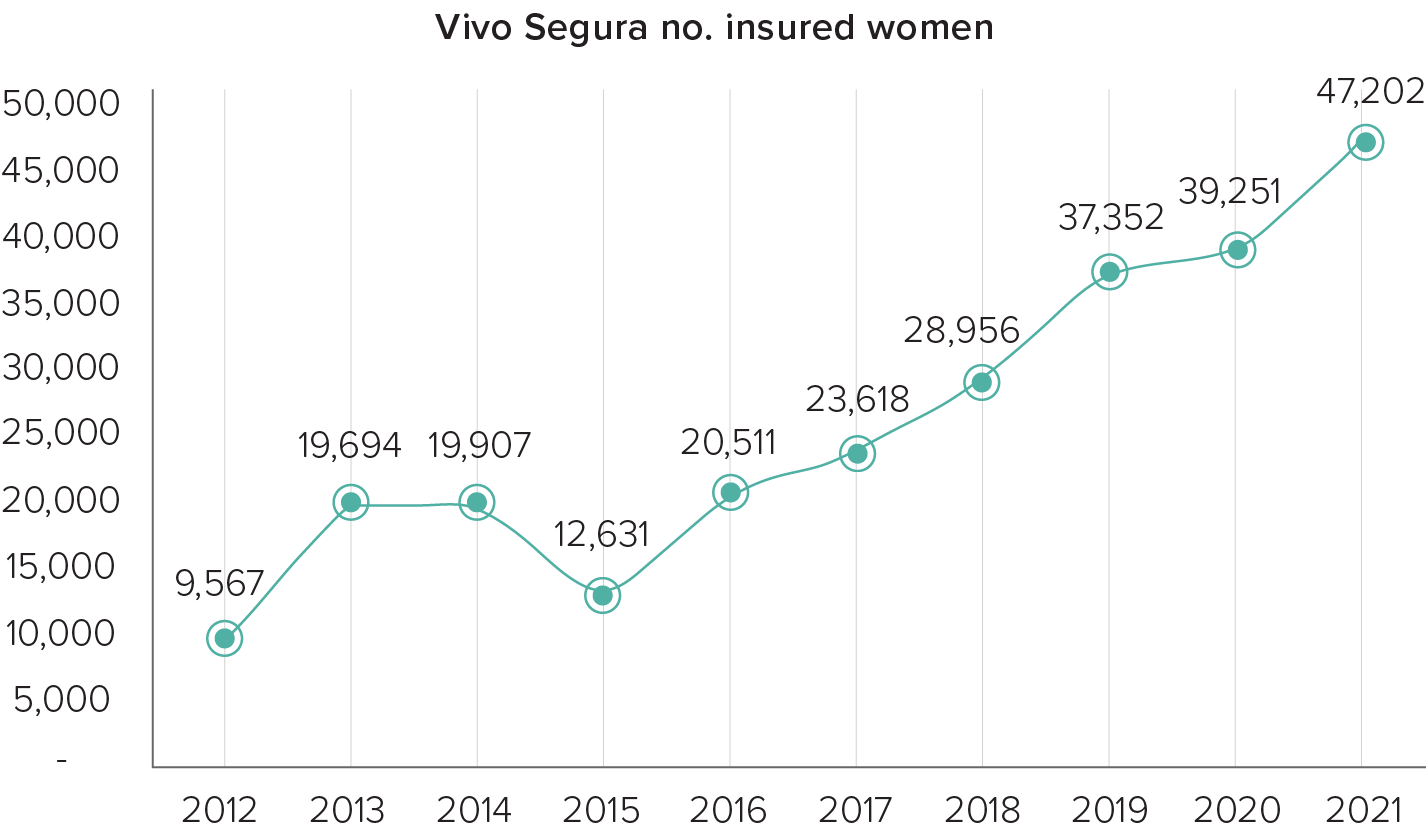
Coverage: 47,202 women (2021).
In 2012, Aseguradora Rural, a leading insurer in Guatemala, developed an insurance product for low-income women clients of its partner bank, Banrural. Over the first year, as the product scaled up, time for training had to be reduced, and staff understanding of the product suffered. This had implications for end client understanding and a more scalable solution was needed to ensure clients understood the product, which had various covers and benefits related to women’s preventative and curative care of gynaecological cancers.
To solve the problem, the insurer strengthened channel capabilities. It increased group promotion activities, developed an e-learning module for bank staff and provided more product information to doctors so that they could also inform clients about the product’s benefits. It also set up outbound call centre welcome calls to remind clients about preventative health benefits and it monitored the quality of information given by sales staff. These calls enabled the insurer to reinforce the value of the product while also conducting quality control of field staff. The initiative has grown steadily since.
For more information, see M. Solana, L.G.F. Gonçalves and A. Merry, “Case Brief: Aseguradora Rural” (Geneva: International Labour Organization Impact Insurance Facility, 2013).
Dealing with post-sales support failure – Econet, First Mutual Life and TrustCo in Zimbabwe*
The product: Life insurance
Description: A freemium product for Econet mobile subscribers who receive up to $40 of life cover for $4 of airtime, $180 for $9 in airtime and $10,000 for $100 in airtime
Coverage: 1.6 million subscribers in its first year.
In 2010, Zimbabwe’s largest wireless network operator, Econet Wireless, established a life insurance product called EcoLife in partnership with First Mutual Life (a prominent insurer in Zimbabwe) and TrustCo (a Namibian technology service provider). The scheme provided life insurance to all Econet customers who enrolled by sending an SMS. Policies were activated as soon as customers spent a minimum of $3 on airtime. Within the first week, 100,000 Econet subscribers had registered for the product and after a month this number grew to 300,000. In less than seven months, the product had been taken up by 1.6 million subscribers.
In 2011, seven months after the launch of the product, TrustCo terminated its agreement with Econet due to a dispute concerning royalties payable. Without the TrustCo platform, Econet was unable to manage the product (as their tripartite agreement did not allow Econet to seek a different technology provider) and suspended the EcoLife service. Overnight and unexpectedly, 1.6 million Econet subscribers (approximately 20 percent of the Zimbabwean adult population) lost their EcoLife cover and were not compensated (although the product was in theory free, many users might have increased their airtime usage in order to qualify for the policy).
Demand side research was conducted in September 2013 to test the impact of the failure of EcoLife on the Zimbabwean market. Of those surveyed, 42 percent were dissatisfied with insurance and 63 percent ruled out use of similar products in the future. One customer explained, “I joined EcoLife, but up to now l don’t understand what happened to it, I was never refunded for my airtime … It is so painful…” Only 17 percent of EcoLife clients indicated they had received formal notification of the product’s discontinuation.
None of the dissatisfied users filed a complaint with the Consumer Council of Zimbabwe or the Insurance and Pensions Commission, but most said they did not trust Econet any more. This was especially problematic since, in 2014, Econet won a lawsuit that enabled it to offer Ecolife once again.
*Adapted from International Labour Organization Impact Insurance Facility Training Case Studies.
5.2. Claims management
Managing claims is arguably one of the best ways to market your inclusive insurance product. If your insurance product has agile claims processes and limited rejections, customers will trust your product and tell their friends, family and neighbours about it. If a claim is not handled well, the same will be true.
Claims management begins in the product development phase, where to be most effective, products need to be designed to be simple and to have limited exclusions and documentation requirements. Low-income, marginalized and rural clients frequently have limited documentation and may not have some formal documents that are common in urban settings, such as marriage certificates, land titles or even medical certificates. They may not have access to doctors who can provide evidence that they do not have pre-existing conditions. They may not know how to obtain a police report or death certificate, or they may lack confidence in local authorities who issue these certificates.
So, you should consider as many alternative methods of verification as possible, including informal records and references from neighbours, lenders and municipal leaders when appropriate (see case study 3.3). With inclusive insurance, which has low margins and large scale, it can be much more cost-effective to investigate a few potentially fraudulent claims than to process many documents verifying eligibility.
Process design is essential. You may decide to centralize the process, by using a free inbound call centre or by sharing the work with a distribution partner. The important thing is to think through the process and ensure that all staff are aware of it, so that customers receive consistent information when they need it most. Remember that even if the insurance company has a toll-free number, some clients might still go to the person who sold them the policy to make a claim. If they bought the claim at a retailer, the cashier at the counter may not be familiar with the process or know how to facilitate it. If the distribution channel is a microfinance institution, the staff may be more familiar with the product and have internal processes to support clients.
Ensure that whatever the point of contact, staff have the right training to deal with the issue. It can also be helpful to train staff to guide clients to the right authorities and even to serve as intermediaries when dealing with authorities in more difficult environments to help smooth the claims process.
Using a customer journey map can help you visualize the process from the perspective of the client, so that you ensure that you are aware of all of these potential issues. Your team can create a map by considering all of the touchpoints in the claims process and imagining how a client might interact with them. Then, you can test the map with your front-line staff, and ideally with some customers who have made claims on other products or from other institutions. You can refer to section 2 on market research for more information on customer journey mapping.
The next step in a smooth claims process takes place at the point of sale. Often, customers do not fully understand the coverage and requirements to make a claim and may be disappointed, even if they are filing a claim erroneously. Therefore, the most important aspect of claims management may be a transparent sales process. Marketing material should be simple, clear and transparent, highlighting the most salient aspects of coverage, and including what is not covered. Claims processes should be understood by front-line staff in advance of sale and incorporated into the operational components of staff training as mentioned in section 4. You can also use post-sales welcome calls (discussed in section 5.1) to reinforce client understanding of the product and of what is and is not covered. Consider practising or simulating various potential scenarios with staff to make sure they understand the process clearly.
Claims simulation exercise
Consider conducting a claims simulation with front-line staff to make sure they are clear on the process. You can choose two or three scenarios, such as these examples:
- Client A has suffered a loss but does not know what documents they need or how to file a claim. How will you support them?
- Client B has suffered a loss and gathered the appropriate documents but does not understand how to file them. How will you support them?
- Client C has provided documentation, but it shows that they are not the beneficiary of their wife’s life insurance policy. How will you handle the situation?
Simulations should also ensure that staff can access a support centre that can answer questions and that they understand the paperwork and processes required on the back end to file a claim.
AI is changing how insurance companies handle claims, helping to make the process faster, easier and better for customers. For example, some companies use AI to sort claims by how simple or complicated they are, so that easy ones can be approved quickly, while more complex cases go to a real person for help. Virtual companies like Lemonade in the United States and Europe do this to approve claims rapidly. Some companies deploy chatbots and virtual assistants to help customers file claims and to answer common questions. AI can also be useful in spotting potentially fraudulent or exaggerated claims. Tools like Shift Technology help companies to distinguish false cases.
When it comes to figuring out costs, AI tools can examine photos or videos of damage, for example after a car accident, and give an estimate for repairs. Companies such as Tractable use these tools to save time in claims processing. AI tools are also being used by companies like CCC Intelligent Solutions to extract information from documents, such as repair bills or medical reports, to speed up claims. Some companies even use AI to handle the whole claims process, from filing to payout. Ping An Insurance in China does this, and has found that it improves claims processing times for customers.
Finally, having a system for tracking claims that is as automated as possible can be very useful. Consider tracking as many of the following metrics as possible and set some targets for when payments are made. For example, in the Philippines, the market has a well-known 1-3-5 standard practice. A client makes a claim on day 1, is informed of the result on day 3, and is paid by day 5. With digitization, this process is beginning to be cut to 24 hours in total. The only way to know if you are meeting client needs on claims is by tracking these data:
- Date an event occurs
- Date when clients inform the channel/insurer
- Date when clients submit all required paperwork
- Date of response (approval/rejection/request for more information)
- Date of payment
- Date of collection of payment.
Understanding why paying claims is the most important part of an inclusive insurance initiative – Pioneer Life in the Philippines
Pioneer Life was one of the first companies in the Philippines to offer microinsurance, and one of the first dedicated initiatives to scale worldwide (which includes its joint venture with the Philippines’ largest MFI, CARD). Pioneer Inc. CEO Lorenzo Chan attributes its exponential growth to one principal factor: paying claims.
In 2013, Super Typhoon Haiyan hit the country. This was followed by Typhoons Rammasun, Hagupit and Jangmi in 2014. Pioneer incurred large losses. “At that time, we were in the red, but continued paying claims”, says Chan. It was a challenging time, with most of the country devastated by the successive typhoons.
During Haiyan, instead of meeting clients in government central hubs, Pioneer set up a table, chairs and a tarpaulin banner in areas where townspeople congregated. When the usual required documentation, destroyed by the typhoon, was not available, the company quickly shifted to alternatives including a simpler claim verification process with the help of its MFI partner and local community leaders.
Some insurers avoided or delayed paying claims and lost customers, but Pioneer soon discovered that keeping its word and paying all legitimate claims quickly would lead to a substantial long-term effect on the business and how it was regarded.
“After 2013, the business grew exponentially. Our enrolment doubled through word of mouth from our customers. But additionally, other partners saw that we were paying claims when their insurers weren’t and came to us. That is what caused our exponential growth!” The entire value proposition to clients, after all, is about claims. “Why else would they buy the product?” adds Chan.

Ensuring client satisfaction through effective claims processing – MFW in Jordan
MicroFund for Women (MFW) is a microfinance institution in Jordan that serves poor women, who make up 96 percent of its borrowers.
The product: Caregiver insurance product
Description: Cash payments for hospital stays, as a mandatory add-on to loans
Coverage: Over 90,000 clients.
In 2010 MFW introduced the Caregiver insurance product (locally referred to as Riaya), which provides cash payments to clients for hospital stays, helping cover incidental costs like travel and lost wages. It was launched as a mandatory add-on for loan clients.
MFW understood that product servicing would be key to success. Claims processing was made more efficient to provide payouts within 10 days of submission. Eventually, MFW was able to handle claims in less than six days.
Loan officers were trained on the product’s benefits and the risks of fraud, allowing them to explain the product and support clients effectively. MFW also started an Insurance Department tasked with detecting fraudulent claims, who introduced clear, transparent procedures for addressing fraud.
By the end of 2012, Caregiver enrolment exceeded 90,000 clients, with claims processing times meeting or surpassing targets. Fraud detection efforts were effective, with rejection rates maintained at 3 percent to 4 percent. Enhancements to the product, such as a 50 percent increase in the daily cash benefit for hospitalization, further reinforced its value to clients.

Innovating to streamline microinsurance claims – MTN, ICICI Prudential and SegurCaixa in Ghana, India and Spain
Some lenders and insurers have taken significant steps to improve how they service microinsurance products by easing the claims management process for low-income clients, ensuring that policyholders receive timely assistance at critical moments.
MTN’s mobile claims process in Ghana
Mobile network operator MTN, with the intermediary MicroEnsure and insurer UT Life, introduced a claims process that allowed policyholders to initiate claims using mobile feature codes.
Once the claim was filed, a service centre representative contacted the client to explain the documents needed and direct them to the nearest MTN outlet. MTN submitted the documentation to UT Life, which paid claims via MTN mobile money to the client’s mobile wallet within six days.
ICICI Prudential’s simplified procedures in India
ICICI Prudential tailored its claims process to meet the needs of rural clients in India. Key adjustments included simplifying claims forms, allowing village elders or community declarations to replace formal death certificates, accepting alternative identification methods like voter ID cards and allowing alternatives to signatures for illiterate beneficiaries.
Service centres were set up in tea estates to better serve tea garden workers. Trusted local representatives assisted families with claims and ensured immediate, localized support. By enabling claim processing directly at the service centres, ICICI Prudential made payouts faster while building trust within the community.
SegurCaixa’s support for migrant workers in Spain
SegurCaixa offered repatriation insurance for migrant workers in Spain. Since beneficiaries often lived in other countries, gathering essential documentation like death certificates could be difficult. To help, SegurCaixa worked directly with consulates to obtain necessary paperwork. This approach eliminated a significant barrier for clients, making it easier for families to claim benefits.
5.3. Monitoring execution vs. targets
5.3.1. Monitoring financial and social indicators
Financial indicators, such as those measuring revenues, claims and profitability, and social indicators, such as frequency of complaints regarding that product, seem very different from each other, but in fact they are closely interrelated. If you ask a person with scarce resources to give you their hard-earned money in exchange for a service, and they are not satisfied with the service you provide, the impact on your bottom line can be severe.
When designing your initiative, it can be useful to look at benchmarks (both internal and external) and set some targets for both financial and social indicators. These should include targets for product updates as well as claims, premium allocation and financial prudence targets. You may have additional internal targets to set, or perhaps your partners would like to meet some additional targets. Discuss these targets in your working group early on in the process of designing your initiative to ensure that you have clear financial objectives and mechanisms in place to track the indicators that matter most to you and your team.
Microfact publishes a list of key performance indicators (KPIs) useful for tracking inclusive insurance (figure 5.2). These include both financial (marked with F) and social indicators (marked with S). Microfact also offers spreadsheets that your team can use to track performance in Microsoft Excel or other spreadsheet software.
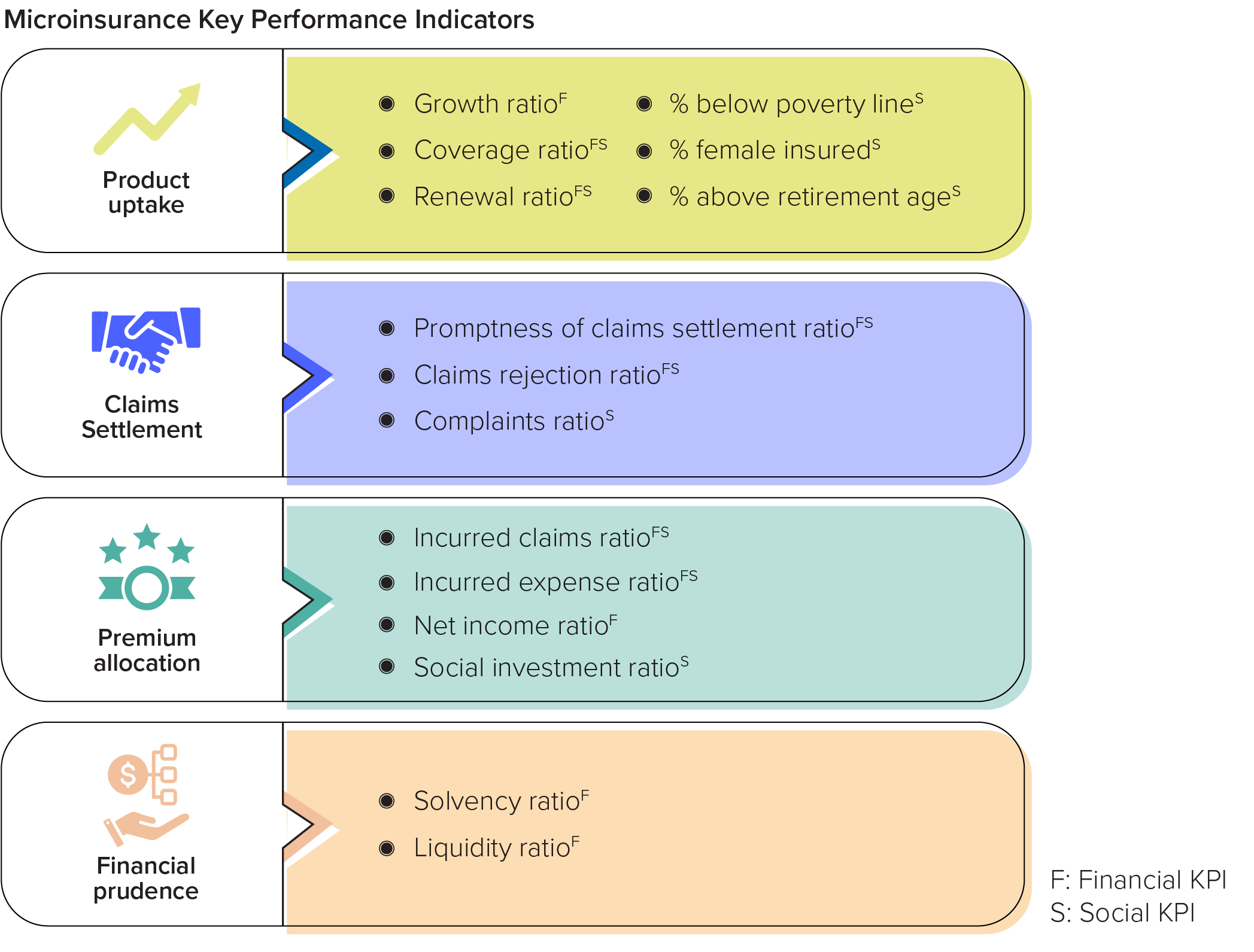
Indicators are an important part of the picture, but institutions should also consider the purpose and intent of their work as they evaluate how inclusive they are, since without an insight into intent, inclusivity is difficult to measure.
5.3.2. Monitoring the client experience
Your client-centric process should be an ongoing one; it should not stop at enrolment, or even at post-sales and claims. Client-centricity requires a constant process of understanding your clients, their needs and the changing market environment. Because of this, you may wish to embed client interaction into your monitoring process to assess client perceptions of your process and product and allow for adjustments along the way.
Various tools can be used for this purpose, and many have been discussed in the market research section of this Navigator. You just need to adapt the questions to evaluate customers’ experience with service, understanding of the product and perception of value to create an effective feedback loop. It is important to work with your partners when going through this exercise. They may be closer to the end customer or have more data that can be used to improve products.
To evaluate customer service and consumer protection, consider mystery shopping. This can help you understand how front-line staff are offering your product and whether they are following sales protocols and ensuring that customers are being told exactly what they are buying and how to use it. CGAP offers a Guide to Mystery Shopping for financial services that can help orient your team on this path.
If you would like to hear what customers think about your product, consider short SMS or phone surveys asking 1–2 quick questions about their recent experience. In these surveys, you can ask basic questions about your product to make sure that clients understand it. This can be much more informative than standard Net Promoter Scores (NPS), which simply ask whether a customer would recommend your product to a friend or colleague. NPS responses can be influenced by bias and be difficult to interpret. Christina Stahlkopf in the Harvard Business Review suggests asking customers questions about their actions rather than their thoughts to eliminate some bias and add nuance to NPS questions.
A brief call welcoming new customers to your product after they enrol can also clarify whether they have understood that they are enrolled and are aware of any payment that they will be making on premiums (see case study 3.1 about Aseguradora Rural for an example). Monitoring your social media can also be essential in some markets to understand where clients might be frustrated. Your most frustrated clients may use social media channels to vent their grievances, and they want to be heard. More and more organizations are experimenting with machine learning and coding social media complaints to track where customers are finding obstacles in their experiences.
If you need to identify any obstacles in the customer journey and understand why they occur, you might consider holding some focus group discussions with customers.
Revisiting a product with qualitative insights – Britam and KTDA in Kenya
In 2007, Britam partnered with Kenya Tea Development Agency (KTDA), a national cooperative association that was set up to support small-scale tea farmers, and which has over 600,000 small-scale tea farmers as members. Britam launched a funeral insurance product to cover tea farmers and their spouses. Around 21,000 tea farmers enrolled in the product in 2007. It was an encouraging start. But in 2008, enrolments began to decrease, and only 3,100 farmers enrolled in 2010.
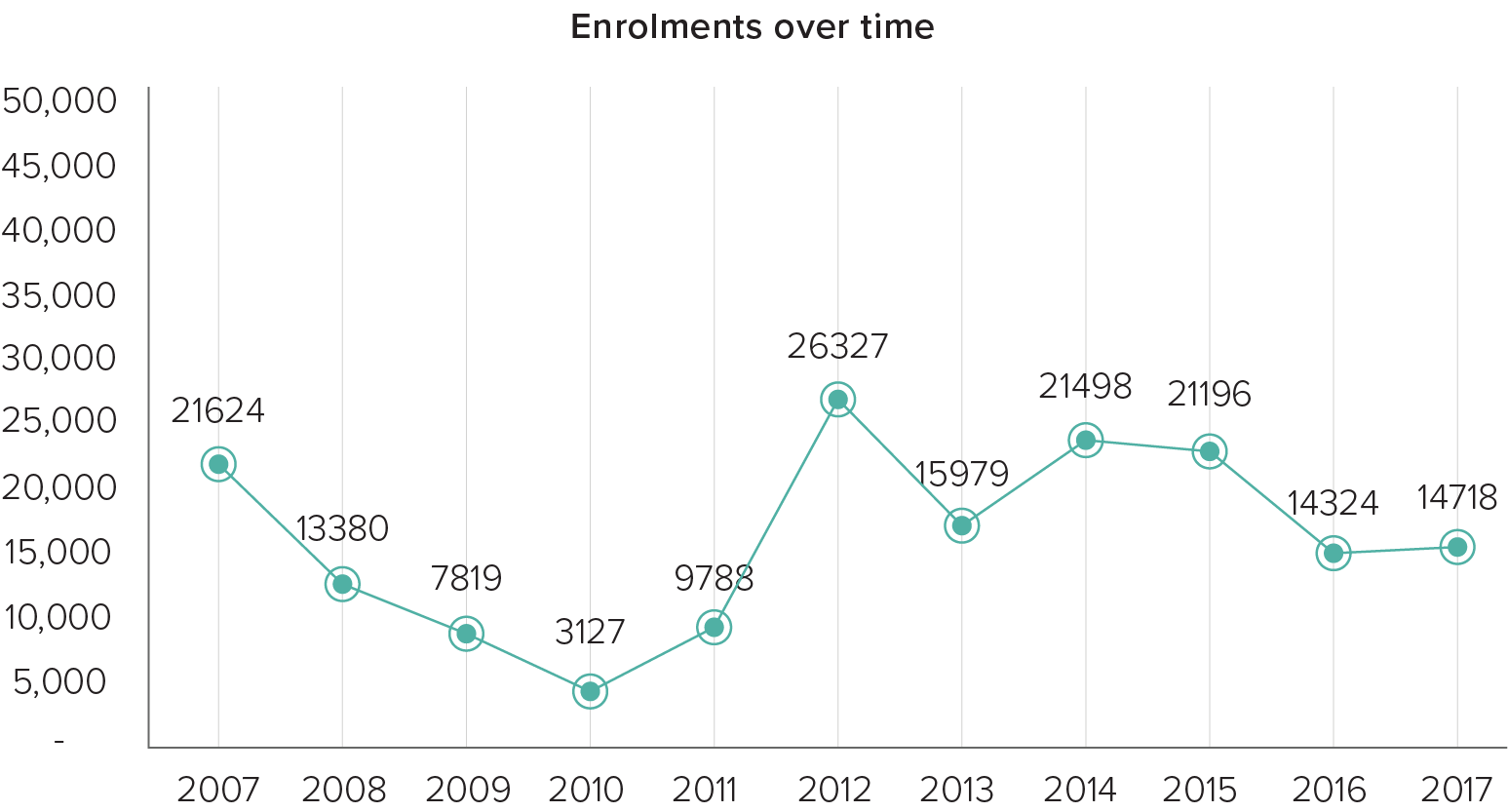
Figure 5.3 shows the 85 percent decline within three years, which was very concerning to Britam. To understand the reason for the decline, Britam decided to conduct customer research with the farmers through focus group discussions and in-depth interviews. This research presented interesting insights:
- Product benefits: Research found that a form of social insurance existed among the farmers, where the community contributed towards funeral expenses to support the bereaved family. This made funeral insurance unattractive, since an informal coping mechanism already existed. Instead, farmers preferred hospitalization cover, because expenses could be much higher and were borne by the family with only limited support from the community.
- Family cover: Initially, the product only covered farmers and their spouses. However, farmers wanted a cover that could protect their entire family, including their children.
- Multiple choices: The funeral insurance product had only two premium options, but it was found that farmers wanted more options so that they could choose the level of coverage based on their needs and ability to pay.
Based on these findings, Britam redesigned the product into hospitalization and surgical insurance with family coverage and provided up to six premium options. This new product was rolled out in 2011 and immediately appealed to the farmers. After the relaunch, the product consistently enrolled more than 10,000 farmers every year. This experience demonstrated that understanding local cultural factors and customer perception is critical in designing a winning product.
5.4. Updating training processes and refreshing
As you monitor the client experience through quantitative and qualitative data, you may learn that you need to adapt your product, change its pricing or change a process to offer a more seamless customer experience. Your front-line staff will need to be retrained or offered a refresher, and materials may need to be updated. This illustrates that your inclusive insurance process is not linear but circular. Just when you think you have reached the end of a process, you realize you need to go back and make adjustments!
In section 4.5.2, we discussed the importance of including an ongoing training refresher in your initiative. Many distribution channels work with models that imply high front-line staff turnover, and it may not be possible to conduct in-person sessions with the frequency needed to keep sales staff up to date. Online training, short videos and training using SMS or chat apps such as WhatsApp can be a helpful complement in ensuring that no one is left behind. Chat rooms and WhatsApp groups also allow front-line staff to ask questions and receive responses on-demand when they are faced with a client who needs answers.
Checklist: Servicing the product
Did the team…