



1.1. About the Navigator
UNDP’s Insurance Risk and Finance Facility (IRFF) has developed this Navigator to address the needs of insurers, distribution channels and other stakeholders planning to develop inclusive insurance products and markets. Starting from scratch in this market can be daunting, costly and time-consuming. To make it easier, this Navigator leverages lessons learned by experts over the past decade and condenses them into practical applications that can be used by practitioners who have varying degrees of experience in inclusive insurance and research methods.
Insurance is a tool for managing the unforeseen risks that can impact financial security and health. It can protect clients’ businesses and farms, not to mention their lives and health, from climate, disaster and unexpected life events. Climate change, in particular, has exacerbated risks, creating an urgent need to expand insurance to a majority of the world’s population. Insurance has a critical role to play in building financial inclusion, helping to protect the lives, health and assets of the majority of the population in the face of these growing risks.
Inclusive insurance represents an opportunity for insurers: it can help them expand and diversify their business model by reaching market segments that are currently excluded or underserved. It can also strengthen the business models of third parties that have strong distribution access to broad segments of the population, enabling them to increase and diversify their revenues, while improving their value proposition.
This Navigator provides resources to support you and your organization as you develop or strengthen a client-centric approach to inclusive insurance. It is centred on the premise that client-centric products and processes can successfully build a sustainable market in which clients understand and perceive the value of insurance products, and are able to realize that value. Only in this way can the insurance sector gain the trust of new customers and ensure their sustained interest in, and commitment to, using insurance products to manage their risks. As you use this tool, you will learn how to create, communicate and offer this value to customers who have not typically been targeted by traditional insurance products. With this in mind, the Navigator offers guidance on how to ensure your approaches are inclusive, empathetic and respectful of differences.
The Navigator covers the entire process of product development, from designing products to selling them and servicing them. Throughout, you will find tools, case study examples and resources for methods and processes. Some research methods discussed are also used in contexts outside inclusive insurance, and in these cases, this Navigator provides insurance-specific examples of their application.
The Inclusive Insurance Navigator is meant to be used by a variety of practitioner audiences working with or within insurance companies and insurance distribution channels. Managers and work teams alike can use this tool. It offers practical hands-on steps, examples and checklists to track progress.
Manager's brief
Each section begins with a Manager’s brief. This box is designed for busy managers who may not have the time to scroll through all the content, but who need just enough information to understand what their teams are working on. Both managers and work teams will also benefit from reviewing the case studies, which illustrate ways in which some of the tools have been applied by local operators.
Your organizational journey into inclusive insurance can be seen as a road that your team will follow. Not everyone needs to follow the same road to achieve their desired result. The market and institutional context matter, as do the goals of your institution. For example: Are you aiming to create a new market in your local context, or is inclusive insurance prevalent in your market? Are you developing a new product, or planning to evaluate an existing offer to improve impact, uptake or claims? Does your institution have existing experience and, if so, what experience exactly? The Navigator offers different tools that can be customized to your needs in each section. It allows you to build the route along your inclusive insurance journey that is most useful for your organization.
Case study 1.1 and case study 1.2 illustrate the journeys of two institutions and show how they used some of the tools included in this Navigator to build their inclusive insurance business.

The inclusive insurance journey of Crezcamos S.A. in Colombia
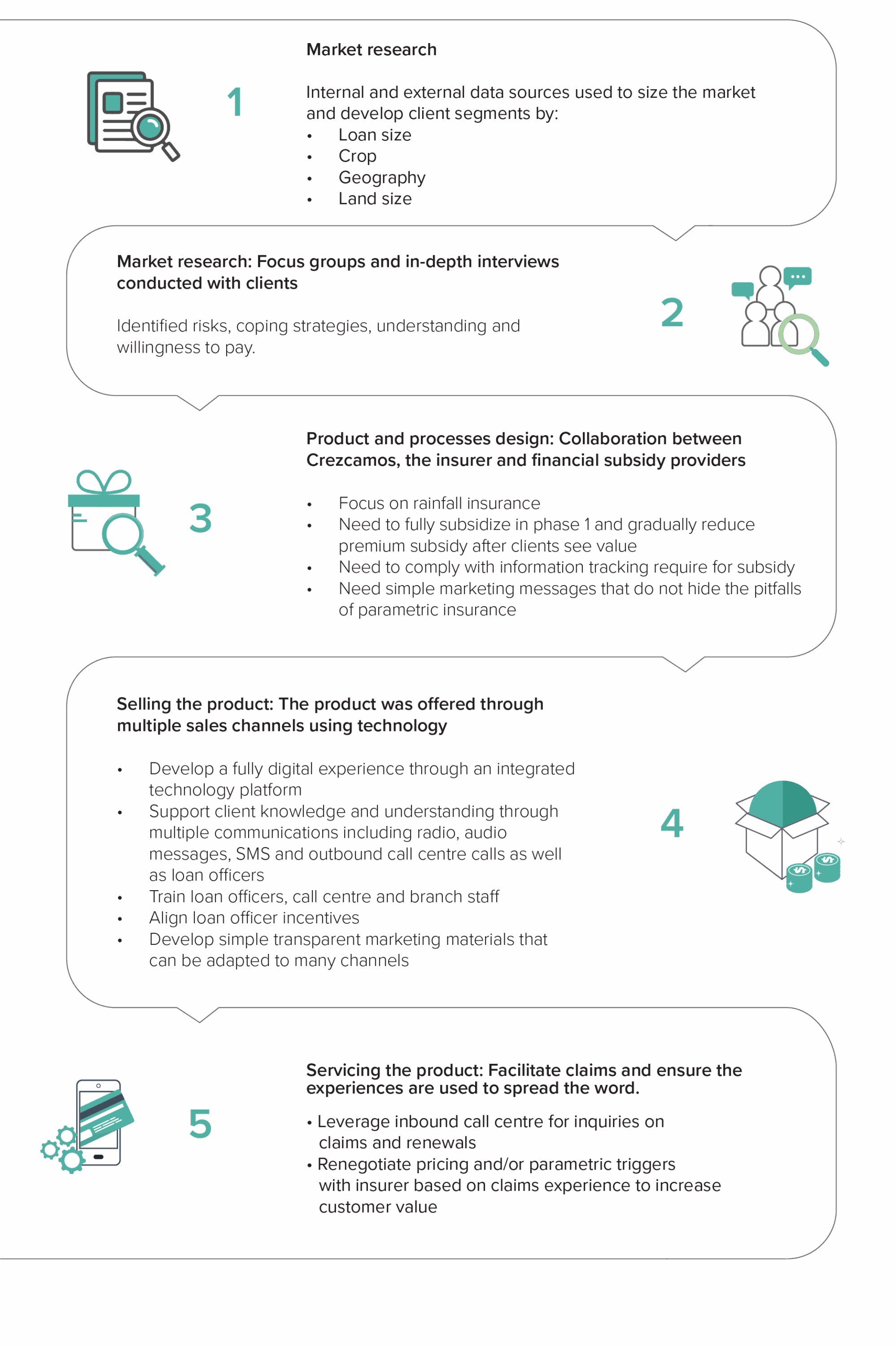
Crezcamos S.A. (Crezcamos), a microfinance institution (MFI) working in rural Colombia, offers multiple personal and property insurance covers for its loan clients. Over 30 percent of its portfolio consists of loans to agricultural clients. As such, the MFI was keen to offer its clients climate insurance to protect their crops from extreme weather events.
Since this type of product was new to the institution and to its clients, Crezcamos chose to engage in the full market research and product development process and hired a consulting firm to manage the process. It used internal data from its credit portfolio to segment clients by crop, land size, loan size and location. This was complemented with external data on the number of farmers in the country by crop to help assess market sizing.
Next, the company segmented the clients and held focus groups with segments that were stratified by crop, loan size and location. It worked with external consultants to hold focus groups and in-depth individual interviews with clients and identify their main climate risks. Smaller loan clients were invited to participate in focus groups, while larger clients with more land were visited for one-on-one interviews. The interviews covered existing risks, existing coping mechanisms and the cost of coping with climate events. They also addressed client understanding of insurance and parametric insurance concepts, as well as customers’ interest in paying for these products.
As a result of the interviews, the MFI was able to approach an insurer with specific parameters for its insurance. For example, only excess rain and drought were ubiquitously cited as damaging to the main crops in Crezcamos’s portfolio.
Since willingness to pay was low, particularly for a new product that had no track record, the institution also worked with domestic and international public agencies to design a subsidy programme that would initially offer products at no charge to “educate” clients about insurance. Over time, as clients began to trust the product, subsidies would gradually be reduced.
Once the insurer had a prototype, consultants returned to clients with the prototype to test various educational materials and marketing messages, as well as channels that would be most effective to promote enrolment. The process showed that it would be critical to explain key concepts like basis risk to clients in order to build knowledge and transparency in the product.
The process also identified the potential for an omnichannel strategy to promote the product through both high-touch loan officer visits and lower-touch call centre calls, audio messages, SMS and radio. The following tools and channels were used to reach target users:
Tools
- Integrated information technology (IT) platform
- Simple marketing materials
- Staff training
- Incentives (indirect)
Channels
- Loan officer
- Brand staff
- Audio messages
- Call centre outbound
- Call centre inbound
- Radio
- SMS
- Social media.
Finally, while loan officers would not receive direct incentives for enrolling clients, they were trained to educate and enrol clients, and to understand that clients who receive payouts are more likely to pay back their loans. Since loan officers receive an incentive for managing delinquency, this was attractive to them.
Crezcamos launched the product in 2020 and placed over 68,000 policies in its first 3 years of operations in 13 departments of the country. Over 4,850 clients have received payouts on the product, which has led to greater interest in paying for the product and more voluntary enrolment through inbound call centre calls.
The inclusive insurance journey of APA Insurance in Kenya
“To develop a product, we use the feedback (from the clients); the clients say the positive and negative aspects of the insurance policy and we correct the product accordingly.” John Kamau, Business Developer at APA Insurance Limited.
The product design and development of APA Insurance (Apollo Group) in Kenya provides a good example of a company that has done market research but wants to improve their products and processes using information. APA Insurance Limited (Kenya) is one of the parent group’s most important companies and has become the largest insurance firm in Kenya. Serving both business and individual customers, it has an innovative range of product offerings.
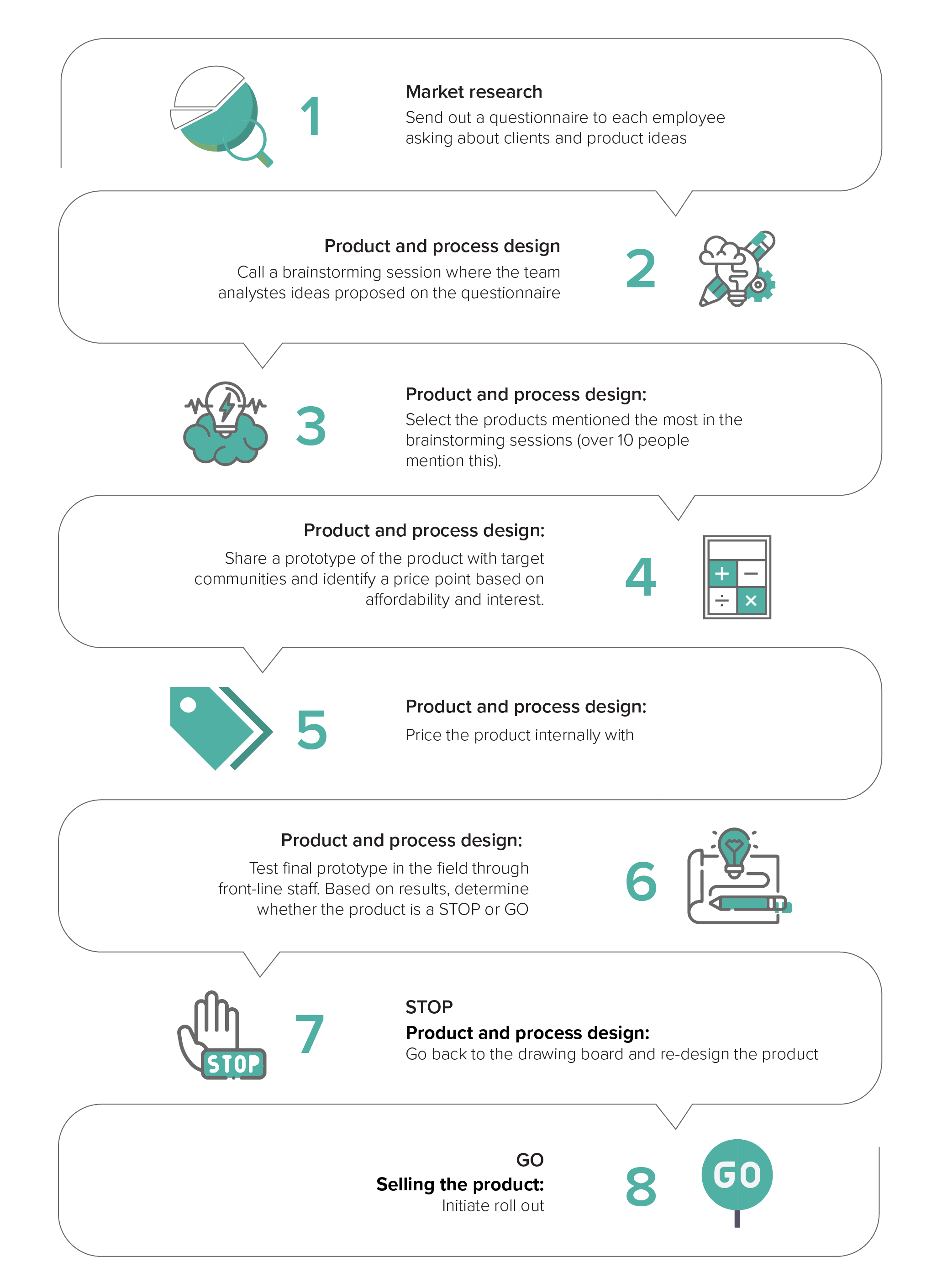
Focusing on bottom-up segmentation, APA develops different activities with staff and potential clients to get input to develop inclusive insurance products, prototype in the field and iterate based on client feedback.
APA’s teams regularly visit different communities to talk to potential and existing customers and gather ideas for new inclusive insurance products. To create a new product, APA uses the method outlined in figure 1.2.
APA also focuses on customer education, regularly organizing groups to explain who the company is and what it can offer, describing the policies in simple terms, giving reasons why acquiring insurance can be beneficial for potential clients and trying to address negative past experiences some people have faced with other insurance companies. The company considers that it is very important to gain communities’ trust and prove through actions that insurance policies can help them in times of need.
1.2. Establishing a working group
Manager's brief
In section 1, your team will learn how to use this Navigator and prepare to develop and offer inclusive insurance products. This section describes important first steps for you and your team.
First, identify the members of your team and develop an internal working group to drive, execute and support your process. This group should be multifunctional, with representatives of commercial, marketing, operational, financial and IT functions in your organization. It may also include your partners.
Once your team is in place, ensure they understand that they will need to use client-centric approaches if they are to develop products and processes that are innovative, new and bring value to end customers. Client-centricity is critical when designing or improving products and services, so that clients understand, perceive and obtain good value from the products they purchase. We discuss in this section the importance of taking a client-centric approach. To do this, consider the team’s existing understanding of the target market and its needs. This can be very useful in framing hypotheses.
An inclusive process that involves clients and those closest to them can help uncover unmet needs and underserved markets. Insurers may not be reaching every market segment in the country because they may not be aware of how to reach them, or even how to identify unexplored segments. In part, this may be because insurers and their teams are very distant from the end customer, and have limited experience of the process of developing products that meet their needs. To help put this right, you need to recognize the internal biases that your team may have and ensure they do not influence your research results and product design.
Inclusive insurance initiatives require the participation of every unit in an insurance company. Distribution channels, such as financial institutions, also need multiple units to be involved to ensure that products, processes and services are client-centred and effective. Every institution embarking on a new initiative or improving an existing initiative should create a working group for this purpose.
Typically, working groups are made up of a commercial unit representative, someone who serves a marketing function, somebody who handles operational issues (such as call centre management), partnership leads, actuarial or financial units and IT units. Internal legal or compliance staff may also be invited to the group to ensure that processes include these considerations from the start. If no internal representative is available, you may consider hiring an outside resource or inviting members of insurance associations on occasion for this purpose.
It can be useful to include someone who represents the clients’ perspective in the working group. This could be a former client or an internal staff member from a similar background to the target client. It may be better to avoid using members of the sales team in this role, since they may have conflicts of interest.
Your working group should also have a coordinator, who may be one of the people selected as a participant, or may be someone assigned specifically to lead the project, depending on your organizational needs. In some cases, a coordinator may be assigned specific staff to support different efforts from time to time.
The working group should participate in the process from its earliest stages, including project planning and design workshops. While weekly meetings are most effective, not everyone needs to participate in these weekly meetings. However, everyone should be informed of progress through memos and called on to participate in weekly meetings at critical times.
Building your working group
As you build your working group, consider including a broad range of functions in your organization, including people with the following responsibilities:
- Commercial
- Technological
- Financial
- Actuarial
- Operational
- Marketing
- Legal/compliance representative
- Partnership development and management
- “Client” representative
- External partners.
Make sure you assign one person to be the coordinator of the working group.
Your working group will need to meet and discuss at various stages on the road to inclusive insurance. Make sure that this Navigator is accessible to everyone. You might even consider assigning readings on different sections of the Navigator throughout the process. As you follow this Navigator with your working group, remember that no inclusive insurance journey is a completely linear process, and that you will need to access different sections of the tool as you go. For example, while we include a section on servicing your product at the end of the Navigator, it is important to set up targets and systems before launching your programme, and in some cases, before even defining your product.
1.3. Recognizing internal biases
The process of developing inclusive insurance products can uncover unmet needs and underserved markets. Insurers may not be reaching every market segment in the country, for the simple reason that they do not know how. They may be distant from the end customer and have limited experience with the process of developing products that meet customer needs.
We might think that we already understand our target population. After all, it may be a population that we know from our family and community. It may even be a population with which we interact daily. For example, your target market might include the taxi driver who drives you to work, your housekeeper, the owner of the small grocery shop on the corner of your street, or your own family members nearby or in more remote areas of your country. We share a country and geography with these people, and we might enjoy the same sporting events, popular television shows or local amenities. We come from a shared cultural history and we may use the same slang and idioms, follow the same rituals and hold the same attitudes. Indeed, we know a lot before embarking on the process of defining a market.
However, some of what we “know” comes from beliefs. It is not knowledge that we have gained from a deep engagement with our target community about the risks they face, how they manage these risks and their financial vulnerabilities. Our beliefs can misguide us into making assumptions about the behaviours of people of different socioeconomic classes, ethnicities, genders, sexual preferences, ages and abilities.
This Navigator seeks to be client-centred, which will challenge us to question what we already know and to listen deliberately to client voices, behaviours and preferences. There may be many differences between our experiences and those of the target population, which may make it difficult to fully understand their financial risks and lives. You may be very different from your target market in terms of education, work and daily life.
To illustrate these differences, we will be accompanied by Eduardo and Erica. They live in a small town in the Philippines (see box 1.2). Eduardo and Erica are personas, which means they represent a compilation of stories and experiences from various people we interviewed as well as some of the literature we reviewed on the region. They are not real people, but using them as examples will help you understand how to apply the lessons in this Navigator more closely.
Meet Eduardo and Erica

Meet Eduardo, Erica and their two children, Justin and Jasmine. Eduardo is a 35-year-old shopkeeper in rural Luzon, the Philippines. He sells groceries. His wife, Erica, is 26 and works at a local garment factory as a salaried employee. Her employer has opened a bank account for her, into which she receives her biweekly pay. She saves about one-quarter of her salary each month. She is very proud of her job because of the money it brings in, which contributes to achieving her family’s dreams. For example, last year, she purchased a small motorcycle on credit that she received through her bank because of her good savings habits.
Eduardo and Erica rent an apartment from Erica’s father, who lives upstairs, in an older housing complex that often suffers from flooding. They pay for the rent in cash from Eduardo’s income at the grocery store. While their apartment is small, it is convenient for Erica’s work, and her parents often help watch their two young children while Eduardo and Erica are at work. Eduardo usually drives Erica to work on the motorcycle before he opens the shop. In the afternoons, Erica takes a mototaxi home. Erica and Eduardo are saving money to buy a place of their own near a private school for when the children are a little older. Keep their stories in mind as you read through this Navigator.
As users of this Navigator, we likely do not fully understand the life experiences of Eduardo, an informal sector worker, or Erica, a textile factory worker. Some of us may live very different lives from them; others may recognize elements from their own experience. Either way, it is important not to start out by making assumptions, because doing so will hinder our ability to create and distribute products that truly respond to their circumstances and needs.
For example, we might see Erica and Eduardo as being very vulnerable and in need of many different types of protection. And this may be true – but keep in mind that they recognize their vulnerabilities and have already worked on strategies to reduce their vulnerability. While they may have little control over some risks, they may manage others very carefully, for example, by diversifying income streams. In this way, they manage risks through their multiple jobs and the support of family members.
Definition
A client-centric organization is one that recognizes that the client’s perception of the value they derive from a product is key to its long-term success. Thus, your value proposition needs to start from the perspective of the client. For example, to serve Erica in a client-centred approach, you do not start with a business problem, like: “Erica has very low income and cannot pay a large premium.” Instead, you start from the client: “Erica has a costly and risky commute to work every day.”
Recognizing internal bias exercise
Think about your own beliefs about your target population and conduct a bias check to identify where your own internal biases may be influencing your thoughts about your target market.
- Ask yourself a question about how a member of your target market, such as Eduardo, might respond to a shock. For example, as a shop owner, how does he manage when he is ill? Does someone else take care of his shop? Does he need to pay that person? Does the shop’s total income fall when that happens, or is it the same? How does he pay for his healthcare while he is ill? Does he use government facilities and, if so, does he get healthier there?
- Now think about your own family and how you would respond to a similar shock if you were in Eduardo’s shoes. Emotionally, you may feel very much the same, but the financial choices you make may be different from Eduardo’s.
- Consider whether you have made assumptions about Eduardo’s situation based on your own experience and possible response to his problem. What factors may Eduardo consider differently? You may be more willing to spend money on what you perceive as better care from more convenient medical facilities, for example, or you may be more inclined to close your shop or pay a worker to cover your job.
This Navigator will help you pose these questions and answer them most effectively to ensure that your inclusive insurance design responds to the actual needs of your target population.

Being client-centric – Listening to inspirational leader
Ovia K. Tuhairwe is Deputy Managing Director at Radiant Insurance Services Company Private Limited in Rwanda, and was involved in the establishment of Radiant Yacu, a specialized arm of Radiant dedicated only to microinsurance, created to focus on the low-income segment in Rwanda.
One challenge in developing the initiative was thinking beyond health insurance provision in the context of the Government of Rwanda’s recent universal healthcare initiatives that addressed many of the health needs of this target population. Radiant Yacu used a client-centred approach to understanding new opportunities in this market and developing products for low-income households that did not duplicate existing government efforts.
Tuhairwe’s team spoke to motorcycle riders to understand their needs. The answer to one question resonated with her, and led to the development of funeral insurance for motorcycle riders and passengers: when asked, “What would happen if you were to pass away?”, drivers replied, “When something happens, we just take off our helmets and we start soliciting money from the public.” This visual picture was worth a thousand words. The client-centric approach helped Radiant sell over 150,000 policies in their first year of operations. Learn more from the LEAD series 2021 with this video:
Claire Burns was MetLife’s Chief Customer Officer between 2010 and 2018. The company is a US-based global giant, providing insurance, annuities and employee benefit programmes to 90 million customers.
When Burns arrived at MetLife, she shifted the company from a product-oriented P&L to a customer-focused P&L. This change was enormous; the company had been organized in product silos that were not intuitive to customers, but were the result of a 145-year company legacy.
A critical moment for the company was the development of customer-driven task forces to jump-start the transition. It established internal forums where teams worked together on a segment, looking at the end-to-end customer experience map, and began designing products, services and other touchpoints with clients from a segment perspective. Key to this process was understanding customers and delivering solutions that addressed their problems and needs, rather than trying to push products that may or may not be relevant to them. Learn more about MetLife’s client-centred journey with this video:
Lorenzo Chan is Chief Executive Officer (CEO) of Pioneer Inc. and manager of Pioneer Life’s microinsurance portfolio. He is also the Chair of the Microinsurance Network. In 2008, Pioneer’s first full year of operations in inclusive insurance, it had 30,000 enrolments and US$100,000 in premiums. The company closed 2021 with 18.5 million enrolments and $35.4 million in premiums.
The company’s growth cannot be attributed to any single factor, but reflects a long-term commitment to growing with the market and learning from clients along the way. One key to its success is that the company has built its strategy around understanding and responding to customer needs. “Our early forays into inclusive insurance were a mistake”, Chan says; when they began working in inclusive insurance, Pioneer lacked knowledge about the market and had lacklustre results. “We combined what we thought we knew about the market with a couple of little focus groups.”
Today, the principle of client-centricity has been incorporated throughout the company, including in the HR onboarding process. New staff are invited to live with clients for three or four days when they join the company, to fully experience their home lives. “In rural areas, they even go to the field with the client.” Chan emphasizes that wearing the client’s shoes is key to getting to know them. “[Staff] may think 2,000 pesos is not a lot of money, but when they live with the customer, they realize it represents their food for the month!”. Learn more about Pioneer’s customer-centric approach with this video:
Checklist: Preparing for the work
Did the team…