



Manager’s brief
Market research can define your value proposition in critical ways, from creating a product that is truly client-centric and responds to customer needs, to designing effective marketing and post-sales strategies that communicate the product’s value and ensure clients receive an excellent experience that will build their engagement, loyalty and long-term value to the initiative.
During the market research process, your team will identify the human resources that will conduct your research; define your research design; analyse the data you gather; and begin to prototype process and product ideas.
In this section, we will discuss how to develop hypotheses and turn them into research questions, as well as how to turn your research questions into tools for data collection. We will also look at the data sources you may want to gather and how they can help you develop inclusive insurance products. These sources include internal quantitative data, external publicly available quantitative data and new data collection carried out specifically for the initiative. When collecting new data, you may choose qualitative, quantitative or hybrid methods.
There is no one way to approach this work. In some cases, institutions may choose to begin with the product and process prototyping and then conduct research to fill any gaps or test their ideas. In other cases, institutions will begin with a hypothesis and test it by conducting research. Some institutions will instead decide to gather some initial data, develop hypotheses from those data, and either conduct additional research or prototype products to test from there. There are many routes available, and this section should be read not in a linear fashion but depending on the route that fits your organization best.

2.1. Who does the market research?
Before you begin your market research, you need a plan to help identify the resources and timing of the research. Your organization needs to consider how much of the work will be done internally and how much will be outsourced.
The decision about who does the research will be a function of your specific needs, in-house capacity and financial constraints. Table 2.1 displays some options and the benefits and drawbacks of each one. You may choose to have different actors contribute to different parts of the process, or you may choose to have one actor take on the entire process. This Navigator can be a useful complement to any of the choices you make.
table 2.1. Who does the market research?
| Actor | Benefit | Drawback | How the Navigator can help |
|---|---|---|---|
| Insurance company (In-house) | - Cost-effective | - Lack of research expertise in-house
- Possible bias in the result |
- Strengthens in-house expertise and helps reduce bias |
| Distribution partner | - Cost-effective
- Staff is closer to end customers |
- Partner may lack in-house research expertise
- May lack time and resources
- May have a limited understanding of insurance possibilities and pricing |
- Strengthens distribution partners’ in-house expertise
- Provides some concrete examples of inclusive insurance projects |
| Market research consulting firm | - Removes bias by using external, objective experts
- Keeps project on schedule and efficient - Relevant experience with research methodology |
- Cost
- Requires significant time in reviewing scope of work and deliverables to ensure they make sense in an insurance context - Requires in-house or external analysis to apply to insurance |
- Can help define a scope of work
- Can help analyse results of market research in-house - Over time, some additional research functions can be conducted in-house |
| Specialized inclusive insurance/finance consultancy | - Relevant experience, using proven methodologies
- Keeps project on schedule and efficient - Understands financial lives of the poor and how financial services needs can be met |
- Highest cost
- Requires expertise in managing external consultancies - May reduce internal engagement and buy-in |
- Can help define the scope of work
- Over time, some additional research functions can be conducted in-house |
| Short-term consultant in-house | - Removes bias using proven methodologies
- Keeps project on schedule and efficient - Understands financial lives of the poor and how financial services needs can be met |
- Additional cost
- May be hard to identify someone with both project management and inclusive finance skills - Consultant may feel less able to make independent decisions about methodology and process so as to conform to supervisors’ approach, thereby losing rigour |
- Can help identify candidates
- Can improve consultant supervision capacity |
2.2. Setting hypotheses and developing research questions
A hypothesis is an informed guess: something you believe based on your prior experience, research or knowledge. For example, based on your own experience visiting clients with sales people, you may think that clients do not understand an insurance product. At this point, your opinion is only an informed guess, and you may want to ask clients additional questions to validate the hypothesis.
Alternatively, you may make an informed guess about something based on internal or external research and data analysis. For example, you may learn that few people in your target market own new vehicles. From that information, you might establish a hypothesis that there is a need for supplementary insurance for used vehicles.
If you host a design workshop as your first step, then your team will create hypotheses in the workshop. Box 2.1 provides more examples of hypotheses and demonstrates how to turn your hypotheses into research questions.
Hypotheses and research questions
When conducting research, it is best to begin with hypotheses. These informed guesses will help you to design specific research questions to explore your hypotheses further. Once you have your research questions, you can transform them into data collection tools (see Box 2.6 and Box 2.7 for this last step). For inclusive insurance research, your hypotheses will likely revolve around some common themes. Here, we list those themes and present sample hypotheses and sample research questions that you may want to use to investigate them.
1. Awareness
- Hypothesis: Most potential clients in my market have never heard of insurance.
- Research questions: How much of my market is familiar with insurance? Where did those who are familiar with it learn about it? Why are others unaware?
2. Gaps in the market
- Hypothesis: Low-income consumers are having trouble financing funerals and may benefit from a life insurance product that covers funeral expenses.
- Research questions: Do other products on the market already offer funeral insurance? In what other ways do people pay for funerals? How much of a burden do the other financing strategies represent?
3. Demand
- Hypothesis: Hospital insurance will sell very well because hospital stays are so expensive.
- Research questions: How aware of hospital costs are potential clients? How worried are they about them? How would they pay for a hospital stay now, without insurance?
4. Distribution
- Hypothesis: Clients will buy insurance through their mobile carrier.
- Research questions: How much do potential clients trust their mobile carriers? Would they want a higher-touch delivery channel so that they can ask questions?
Setting up a hypothesis – Fundación PROFIN Bolivia
“You have to create a product that suits the needs of the client, so always start with a demand study” – Erika Pacheco, Insurance Coordinator, PROFIN.
The Foundation for Productive and Financial Development (PROFIN) is a market facilitator and non-profit dedicated to promoting financial inclusion in Bolivia. With financing from Swiss Cooperation Bolivia, PROFIN developed an inclusive insurance project called “personal accident insurance in the court”, a client-centred product offering insurance coverage for sports teams.
The product: Personal accident insurance in the court
Description: Medical coverage of personal accidents that occur while participating in a sporting event
Coverage: More than 10,000 athletes.
PROFIN used a human-centred design process to design this innovative product. The idea originated with a PROFIN staff member who was an active soccer player and who suggested there was a need for accident coverage for participants in amateur soccer matches. PROFIN found the idea innovative and interesting and transformed it into a set of hypotheses, as follows:
1) Soccer players are at high risk of accidents on the field
2) Soccer players are not especially concerned about accidents that they might have off the field
3) Soccer leagues would be willing to distribute insurance to their members to ensure greater safety and sense of belonging among members.
The PROFIN team then designed demand-side market research to better understand the size of the market, test their hypotheses and ascertain potential interest in coverage. They partnered with sports leagues, which provided access to players and input into the product design process. The results of their research (focus groups, interviews and survey) showed a strong interest among amateur players, who were looking for something simple, inexpensive and very short-term (for example, a product that covered accidents during a single match).
PROFIN designed just that – a simple product that could cover accidents only during a single soccer match, including accidental death – and then identified an insurance company partner with a good medical network to offer the product. To test the product, they partnered again with sports leagues, which promoted it among their teams.
Once the product began to roll out in the market, PROFIN was able to calculate more accurate numbers on the risk and accident rate for this product. This allowed some iteration and improvements, including improved coverage, lower premiums and expanded eligibility that included other sports such as basketball and volleyball. The product was so successful that other insurance companies started to offer similar products.
To learn more about this experience, visit the PROFIN case study on the Microinsurance Network page.
2.3. Identifying client segments, typologies or personas
Developing inclusive insurance products requires truly knowing your current and potential clients. This includes demographic and financial characteristics, but also more abstract features, such as preferences, fears and values. Client segmentation is a very useful tool in market research, because it allows you to define the client types to focus on when you collect data. For example, if you see that a certain client segment is underserved, you may want to focus research efforts on that segment.
Definition
Segments are clusters of people that can be identified by observable characteristics. They may share similar experiences and aspirations. Each cluster is also likely to share a similar understanding of insurance, insurance needs and potential interest in purchasing new products. For example, Erica may be in the client segment of young women with salaried jobs and bank accounts, while Eduardo may be in a client segment of informal small business owners.
Segmentation allows you to group clients by their different needs. It will help group your target clients in ways that make the most sense for product design, distribution or servicing. Once you understand the specific needs of groups of clients, you can see the commercial benefits of customizing products, distribution and servicing a bit more to ensure every group is well served.
Even before you begin your research, you may have some ideas about the segments you want to target: for example, you might want to aim your product at rural women with loans from microfinance providers, or at urban bus drivers. A segment needs to be large enough to be attractive and have measurable characteristics that allow you to differentiate it from other segments. Some segments may be too broad, such as “bottom of the pyramid”, which would encompass many different types of people with different needs and financial capacities. Other segments may be too narrow: for example, “hairdressers” might contain too few people to justify a product. A measurable segment might instead be “urban businesses”, or “rural farmers”, or “factory workers”.
Gender is an important consideration when segmenting, as women and men often behave differently and have different needs resulting from household roles, social norms and economic inequities. But segmenting between men and women is not enough. Some women are wives and mothers, while some are single; some are employees and some have informal businesses, and so on.
Your client segmentation will only be as good as the data that you have, so having more data leads to more accurate client segments. Think about the segments and people you are planning to target. This will help you identify the internal and external data that you might need to deepen your understanding of these groups and validate that they are indeed an attractive market segment. It will also help you plan your data collection process if you are planning to conduct your own market research. Once you have some data, you can identify client segments using a range of methods, which may be as simple as descriptive tables or as advanced as machine learning clustering algorithms. If you lack data, consider the bottom-up segmentation technique explained in box 2.2.
After you identify your segments and understand them better through some research, you can assign these “typologies” using your data and understanding of the market. You may then want to personify these groups, creating “personas” that make them come alive within your team or when explaining their needs and behaviours to managers or potential partners.
Personas are fictional, but based on real information about clients. They can help bring to life, through description, an example of the type of person you are grouping into a segment. They may be a composite of different people you interview in a segment. Ideally, you should create personas with some research from the segment in hand, which will contribute to your understanding of the group more fully.
For example, Erica is a persona. She is not a real person. But in rural Indonesia (see case study 2.2), we met many women like Erica who worked in factories as employees. Many of them were offered multiple financial services, including direct deposit, through their work. Many travelled to work on motorcycles, and many had dreams of home ownership. From our conversations with these women, we could create a persona, whom we named Erica, that can help us imagine the person for whom we are designing when we start our product design process.
When you create personas, consider how gender disparities and social norms may influence the person and their perceptions of risk, financial vulnerability, knowledge and interest in insurance. Consider also whether some groups may have greater access than others to transportation, technology and information as you think about channels for enrolment, payments and claims. This will ensure that your persona is a reflection of your efforts to empathize with and understand your potential clients.
A final note: client segment development might be an iterative process. You might identify certain segments and then during external data collection find that they are more fluid than expected, or that you missed sub-segments. So, after you gather additional information, iterate and revisit your segment.
You may not always have access to adequate data sources to define segments. Bottom-up segmentation can validate hypotheses about market segments in your current market drawn from quantitative data or, in some instances, can entirely replace this information with insights from the people who have regular contact with your current or target clients. Box 2.2 offers guidance on conducting bottom-up segmentation in a focus group setting.

Bottom-up segmentation
A bottom-up segmentation exercise is very similar to a focus group. Your team will want to gather 6–8 people who know the market best – these may be field staff from a distribution channel or your internal staff. These staff members should have gained valuable information through interactions with clients, including about the questions that clients and potential clients ask, the types of products that garner the greatest interest and the hesitations people express. Neither clients or potential clients should be among the participants.
Step 1. Ask participants who their “typical” clients are and begin to build profiles of these clients to understand some of the main characteristics of different groups. Identify demographics such as the age, gender, occupation and risk exposure of each group. Stay organized by keeping a list on a board that everyone participating can see.

For example, one segment might be formally employed low-wage workers (like Erica), and another might be informal small business owners (like Eduardo). Other segments might be organized around occupation (for example, a segment of factory workers, taxi drivers or household workers), risk exposure (those living in a flood zone), or age and gender (women of child-bearing age). Take some notes on the board as a group to describe these segments in more detail.
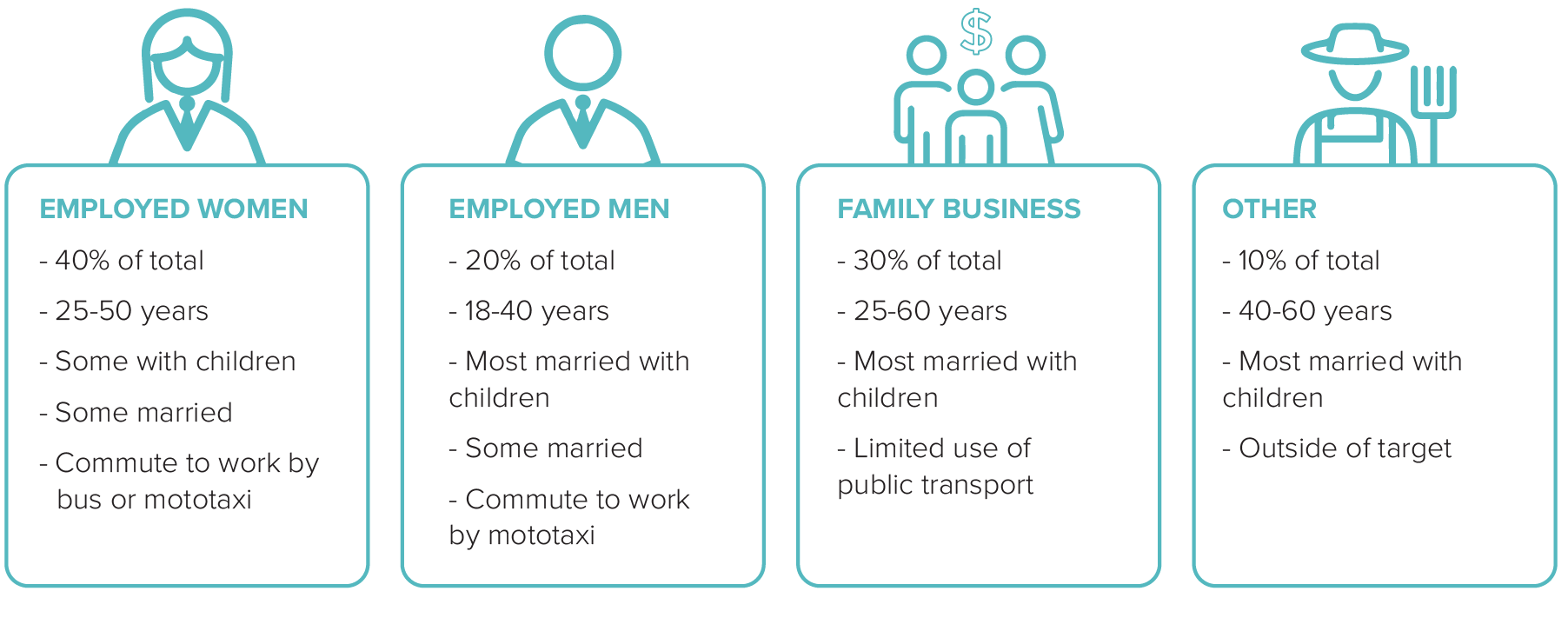
Step 2. Once participants have identified typical clients, discuss each segment’s financial and digital awareness, along with any characteristics that are important to the products that you are developing. For example, if you are developing a health product, you might want to identify which segment is most likely to need healthcare.
Taking the example of Erica’s segment, employed women, for example, what might the focus group participants say? Maybe that this segment might not be interested in health insurance, because they may already receive it from their employment. However, they might be interested in accident insurance to support their family if they have an accident and are unable to work. They might also be interested in micro life insurance coverage to protect their young children. Figure 5 illustrates how you might document this on your board in collaboration with your front-line staff.
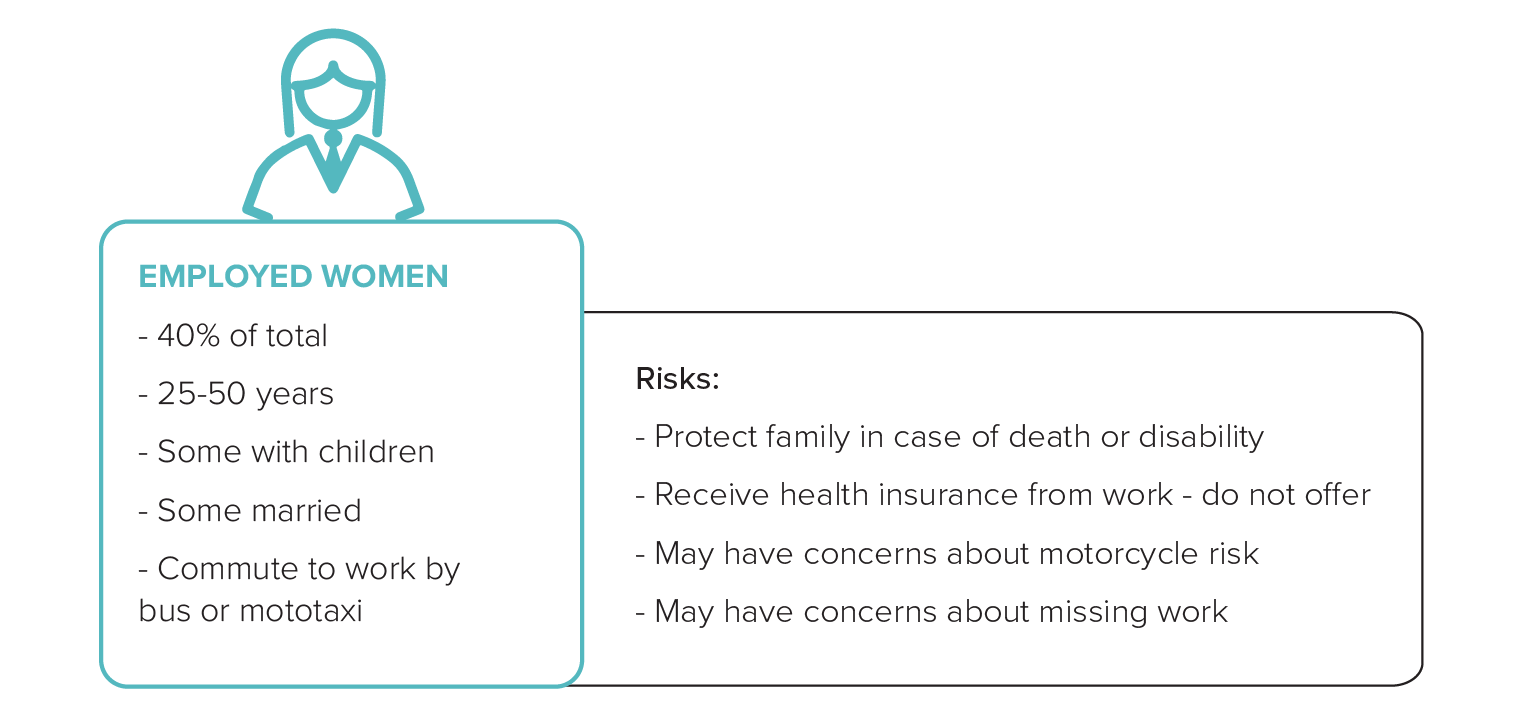
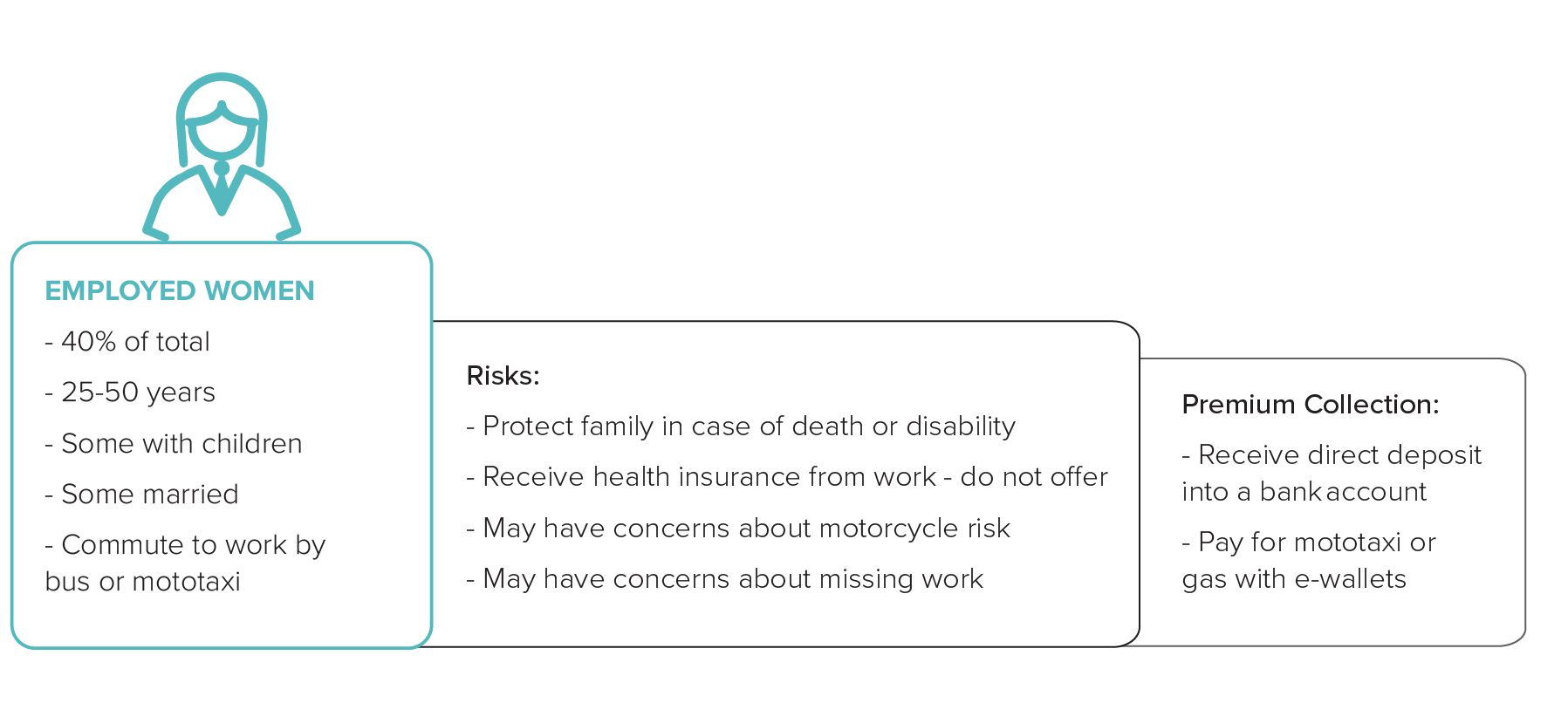
Step 3. Next, discuss the commercial approach for each group. How do they prospect? Which products do they use? Which products might they need? What distribution channels do they touch?
Erica’s segment, for example, might be reached through the bank where they receive their direct deposit from work. They could also be debited through a mobile app when they pay for their mototaxi on their daily commute.
Identifying client personas through focus groups – AXA Mandiri, Indonesia
AXA Mandiri wanted to add new products to their microinsurance line. It had an existing partnership with a distribution channel, Mandiri Bank, through which it distributed three insurance products.
AXA began the market research by conducting a bottom-up segmentation exercise with Mandiri Bank tellers and agents. The bottom-up segmentation exercise was conducted at a branch during the employees’ lunch break, and began with the question: “What does a Mandiri Bank household look like?” Bank employees agreed that nearly all Mandiri Bank households had a salaried member that acted as the household’s “insurance” – which was identified as an important detail to consider in thinking about household vulnerabilities.
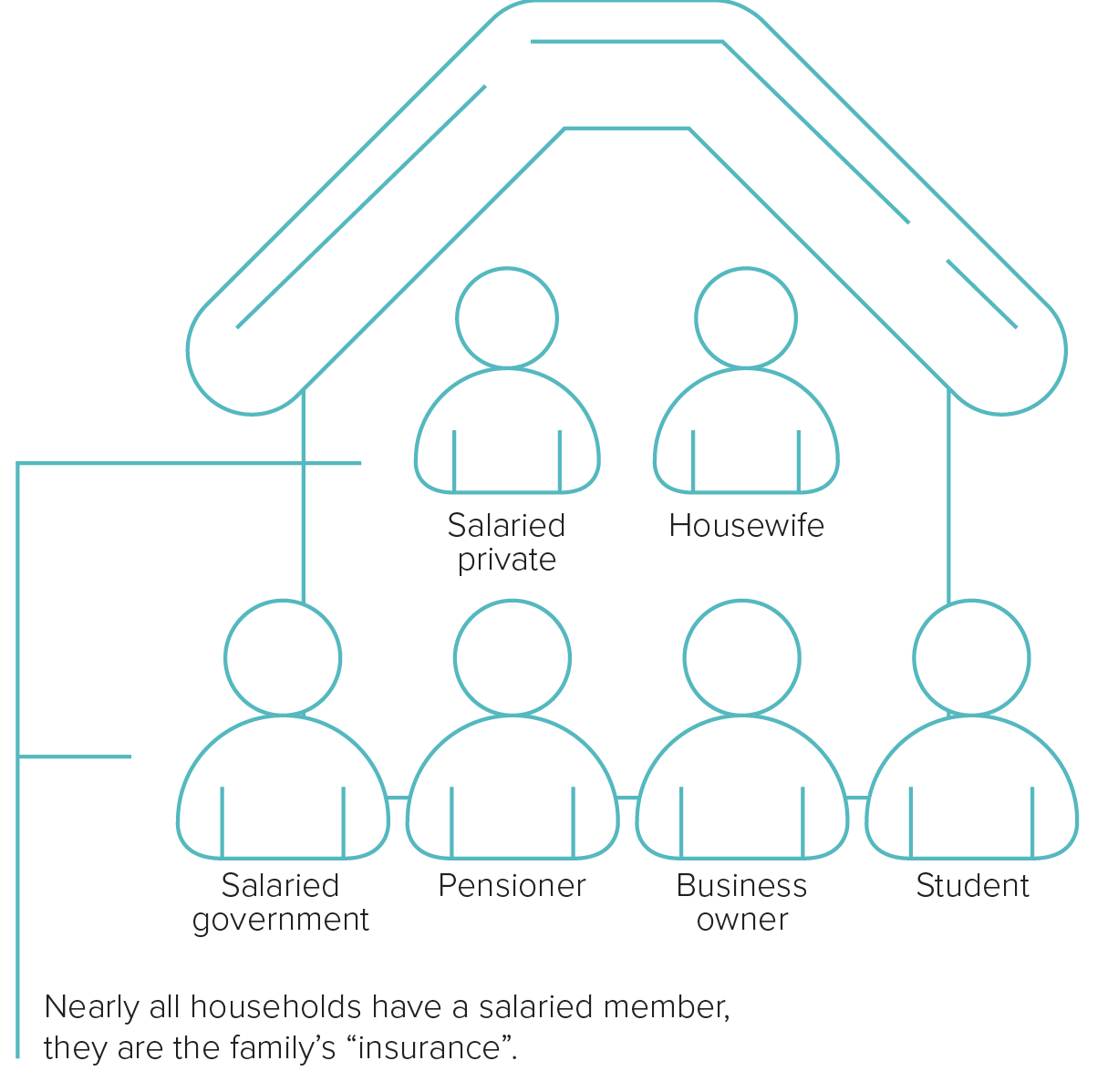
They then discussed the gender and occupation of bank account holders and split the account holders into a few segments, noting that the biggest and most active segment was made up of female salaried workers making minimum wage. They also agreed that this segment was the one that most often purchased insurance, estimating that about 80 percent of insurance purchases through Mandiri Bank were made by salaried, minimum wage earners who were women.
This information allowed AXA Mandiri to target market research towards the segment of bank customers that were already familiar with and interested in insurance products: women on payroll making minimum wage. Through that research, AXA Mandiri found out that these salaried women were worried about the risk of a traffic accident when traveling to and from work, which they did on motorbike taxis. AXA Mandiri developed a product that covers injuries to motorbike passengers, and in doing so, determined that the best distribution mechanism would be through rideshare apps.
Using behavioural customer personas to design a client-centric inclusive insurance product strategy – Britam in Kenya
In 2018, Britam was looking to reposition its microinsurance business to expand its scope by covering emerging risks in the digital and climate change space. Britam decided to adopt a client-centric approach to reorient the business. The company first conducted client segmentation research using behavioural factors instead of demographic ones. It identified five different customer personas for its inclusive insurance business, as well as each persona’s perceptions and attitudes.
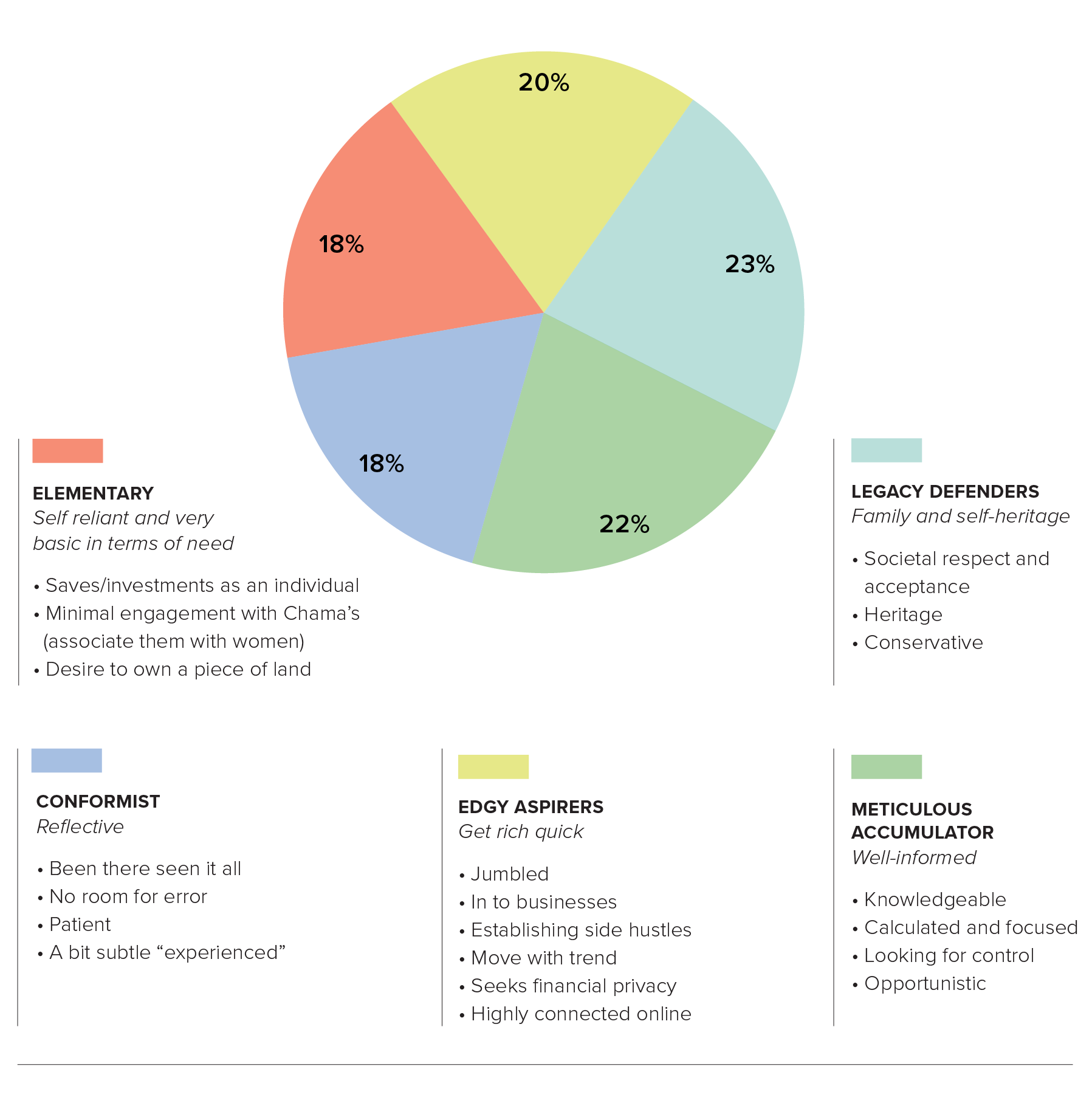
In the next step, Britam was able to set up a comprehensive strategy for each of these personas using targeted products and distribution approaches:
table 2.2. Strategies to target personas
| Persona | Behavioural profile | Demographic profile | Examples | Appropriate products | Appropriate distribution |
|---|---|---|---|---|---|
| Meticulous accumulator | Knowledgeable, calculated and focused on growing wealth | Men and women, mostly aged 35–45 | Owners of small and micro enterprises | Business interruption covers, savings-linked covers | Digital and formal credit institutions |
| Elementary | Self-reliant, hardworking, focused on basic needs in life | Mostly urban/peri-urban self-employed males under 40 with limited formal education | Self-employed such as farmers, mechanics, artisans, etc. | Business and health covers, climate insurance for crop and livestock | Agents, microfinance institutes |
| Edgy aspirers | Risk takers, hustlers and online generation | Well-educated, formally employed urban men and women millennials | Salonists, gig workers, etc. | Investment-linked insurance, mobile and income replacement covers | Telcos, mobile money and other digital platforms |
| Legacy defenders and conformists | Conservative, with societal respect and family heritage as driving factors | Well-educated, formally employed men and women aged 40–55 | Formally employed private and government level 2 and 3 workers | Education policies, savings-linked, health, life and property cover | Formal financial institutions such as banks, savings and credit co-operative societies (SACCOs) and agents |
Britam then repositioned its business from microinsurance to emerging consumers with a customer-first tailored strategy for each persona. Since the repositioning, Britam has been able to enrol over 1.2 million customers across the above personas as follows:
table 2.3. Outcomes by customer persona
| Customer persona | Product & distribution | Number of Customers |
|---|---|---|
| Elementary and meticulous accumulator | Health covers distributed through intermediaries | 211,416 |
| Edgy aspirers | Micro moment insurance distributed through telcos, ride hailing and e-commerce platforms | 325,411 |
| Legacy defenders and conformists | Credit linked covers through banks and SACCOs | 602,000 |
| 1,138,827 |
2.4. Selecting your data collection methods
Once you have broadly sketched your segments, your working group can use them to identify what information you are missing about your segments. You may be able to use existing data from internal or external sources to supply this information. Any remaining research gaps need to be filled with new data collection using quantitative or qualitative tools.
Collecting quantitative data will allow you to gather information from a larger sample and generalize your findings to the market segment. These data are numerical or statistical, and best suited to answer questions like “how much?”, “how many?” or “which one?” Qualitative data, on the other hand, are valuable because they include the kind of descriptive information that allows you to gain insight into your market’s underlying opinions, reasons and motivations. These data are best suited to answer “why” and “how” questions.
Table 2.4 can help you identify which methodology or type of tool to use, depending on your research questions and gaps.
table 2.4. Matching research questions to an appropriate methodology
| Question subject | Internal data analysis | External data analysis | Qualitative: Interviews | Qualitative: Focus groups | Quantitative surveys |
|---|---|---|---|---|---|
| General objective | Good for answering the question “How many?” | Good for answering the question “How many?” | Good for answering the questions “Why and how?” | Good for answering the questions “Why and how?” | Good for answering the questions “What product/service/channel?” |
| Quantifying market size | Determining market size | Determining financially viable size of the market with demand for a product* | |||
| Client segmentation | Identifying and quantifying client segments | Identifying and quantifying client segments | Identifying attitudes, needs and behaviours of client segments | Identifying attitudes, needs and behaviours of client segments | Identifying and quantifying client segments* |
| Risks | Identifying mortality, unemployment, debt default data | Identifying mortality, health, accident and climate risks in a country | Identifying the types of risks that concern clients and are hard to manage | Identifying the types of risks that concern clients and are hard to manage | Identifying the types of risks that concern clients and the costs of managing risks * |
| Product pricing | Identifying client transactional and financial behaviours (payments, loan disbursements, savings balances, etc.) | Identifying ability to pay | Identifying willingness to pay (approximate) | Identifying willingness to pay (approximate) | Identifying willingness to pay |
| Mitigation strategies | Identifying specific costs of and financial strategies for managing an insurable event | Approximating costs of and financial strategies for managing an insurable event | Identifying specific costs of and financial strategies for managing an insurable event* | ||
| Preferences | Ranking preferences | Ranking preferences | Ranking preferences* | ||
| Insurance sensitization | Identifying product understanding | Identifying product understanding | Identifying product awareness* | ||
| Marketing language | Understanding language used by clients to describe events, losses and fears | Understanding language used by clients to describe events, losses and fears | |||
| Potential distribution channels | Identifying client transactional and financial behaviours (payments, loan disbursements, savings balances, etc.) | Identifying client financial services utilization in the country | Identifying client engagement with and trust of distribution channel | Identifying client engagement with and trust of distribution channel | Identifying client use of specific financial services and touchpoints* |
| Evaluating existing products | Documenting internal process and IT failure rates and client and partner complaints information | Identifying friction in the customer journey | Identifying friction in the customer journey | Discerning client satisfaction levels with specific operational issues* |
Internal data sources
Internal data can be a valuable tool in designing a demand-driven product. If you or your distribution partner have worked with clients in any capacity, these clients may be a great target market to start with when offering inclusive insurance for the first time. You already have a trusted relationship with them, you likely already have some data on them that can help you design products, and you can reach out and speak to them to learn more.
In developed or saturated markets, designing products for a current client base can allow providers to take advantage of existing relationships and build brand loyalty without directly challenging first movers. It can also facilitate a smoother entry into a market that is underdeveloped, because your current client base is made up of the type of people who are willing to engage with a financial institution.
Internal data from financial service providers

Financial services providers (FSPs) that make loans to informal sector workers often have data on these workers that can help insurers price their mortality risk. These workers tend to be of working age and strong enough to work every day. As a result, they may have a low risk of mortality. Some lending organizations also cover their loans in the case of death and can identify the likelihood of death very precisely. For example, by reviewing internal data, you may discover that Eduardo has a low likelihood of death.
Internal data can come from an insurance company’s people and systems, or from those of your distribution partners (financial services provider, mobile network operator, etc.). Internal data can tell you things about your clients (age, gender, family characteristics, address, online/social media engagement, claims or loan records and payment or sales receipts, etc.) and about some of their risks and behaviours (mortality, repayment struggles, etc.). However, they cannot tell you very much about why your clients make the choices they do. If you only have resources to use internal data, you can make some hypotheses or guesses about your clients’ needs. But remember, these are only guesses until you test or validate them.
Internal data can be general or specific. You might have data that are not client-specific, such as the geographic areas in which loan officers work. Alternatively, you might have very detailed client data, such as yearly income or alternative credit scores. If you begin to develop client segments, typologies or personas before this step, these data can help you segment the market and refine ideas around the specific types of people you are targeting. Table 2.5 gives some examples of internal data sources and how you might be able to use them.
table 2.5. Potential internal data sources
| Data | Queries | Use these data to… |
|---|---|---|
| Client demographics | - Ages
-- Mean age -- Age categories - Gender - Location -- Rural/Urban/Semi-urban -- City, town or neighbourhood - Occupation - Household size - Income - Loan size/type |
- Build client segments or client personas that describe the clients by type
- Make some guesses, or hypotheses, about the types of risks and needs that clients may have by segment. |
| Risks | - How many clients are in riskier age groups?
- What economic activities do they engage in, particularly risky ones? - Are there security risks in the areas where clients most commonly live? - What climate risks are common in the region? - To what extent do your clients rely on salaried employment to live? - Is there a public health system available and what services are included or excluded? - Which clients have stronger credit scores? |
- Identify some guesses or hypotheses about the risks clients face and which they need to cover. This information is best used when considering client segments and developing profiles of “typical” clients, or personas, and guessing about the risks different client types or personas may face. |
| Sales | - Which products sell the best?
- Who buys which products? - What sales channels are most effective? |
- Consider which sales channels are trusted, which payment channels are common and which types of products your clients prefer
- Identify the most common products currently used by clients (for example, group loans). These can then be used as a starting point for developing product bundles with insurance cover. |
| Mortality or claims | - How frequently do your clients pass away?
- If you offer insurance already, which products see the most claims? - What segments of clients make the most claims? - What segments do not make claims? - What is the average claim amount? |
- Help support pricing decisions by showing typical mortality rates, for example, of the unique population you are targeting. This may be different from those shown by standard actuarial mortality tables.
- Identify which segments benefit most from existing products and which may be underserved, where insurance data are available. Then, you can target underserved clients with new products, or work with them to ensure that they understand the claims process of existing products. - Identify the potential risks to the insurer, where insurance data are available, including fraud and moral hazard. |
| Payments (premiums, loan repayment, etc.) | - What types of payments are late or are never made?
- What time of the year or season do clients have more or less access to cash to pay for premiums? - What client segments make late payments, miss payments, or drop out because they do not make a payment? |
- Learn where clients are struggling to meet a financial responsibility or where there may be an operational barrier to payment that disincentivizes timely payments
- Identify when and whether to change payment channels (for example, are digital payments more often made than cash?) or change payment schemes (maybe lump-sum payments are less frequently made, which might mean it is better to shift to instalments). |
Using internal data for product development – LOLC in Cambodia
“The challenge in the research is that sometimes the research project can’t get the fully correct information. Responses may be biased … but data is not biased. We rely on internal data from the microfinance institution for the product.” – Ban Phalleng, Chief Operating Officer, Serendib Microinsurance Plc. Cambodia.
Serendib is a fully owned subsidiary of LOLC Group, a business conglomerate and proprietor of LOLC (Cambodia) Plc., which with over 25 years of experience is one of the leading microfinance institutions in Cambodia. Serendib was born out of business opportunities identified by LOLC Group and inspired by the group’s successful experience with insurance in Sri Lanka.
In developing products, the Serendib team has abundant knowledge of statistical and data analysis available to them, but a key challenge is finding reliable data about the current market. They have found it hard to rely on survey research findings to evaluate whether hypotheses are fully true or not. So, they have developed alternative strategies for using client data for product development.
Serendib has leveraged its on-the-ground exposure to clients through the microfinance business, as well as a large amount of data collected over the years from microfinance clients to better understand clients’ insurance needs and create new client-centric products. For example, with the credit data from over 200,000 clients, the company does not have to rely on external data sources to develop its own qualitative and quantitative research to design new innovative products that target the market.
To learn more about Serendib Microinsurance Plc. you can visit its web page.

Using internal data to develop an effective distribution model – VisionFund International
“As a microfinance institution network, selling insurance as part of a package of financial services – embedded with a loan or savings account – is the most efficient model to bring safety nets to vulnerable communities” – Théo Dervaux, Insurance Operations Director, VisionFund International.
VisionFund International (VFI), the financial arm of World Vision International, is committed to improving children’s futures through financial services. Working in 25 countries, VFI impacts 4.25 million children’s lives and insures more than 2.5 million people through 50+ programmes.
VFI implemented voluntary insurance pilot programmes for more than a decade, but results showed problems with the model. Voluntary insurance models, in which clients fully opt in or purchase stand-alone policies, often failed to achieve scale and sustainability. VFI’s data revealed that key challenges included high acquisition and distribution costs per policy, adverse selection leading to higher premiums and financial risks, and limited reach, which made it difficult to generate positive word-of-mouth or showcase evidence of impact.
VFI addressed these issues by developing embedded insurance models, in which insurance is bundled with loans or savings products, creating a sustainable, virtuous cycle (figure 2.7).
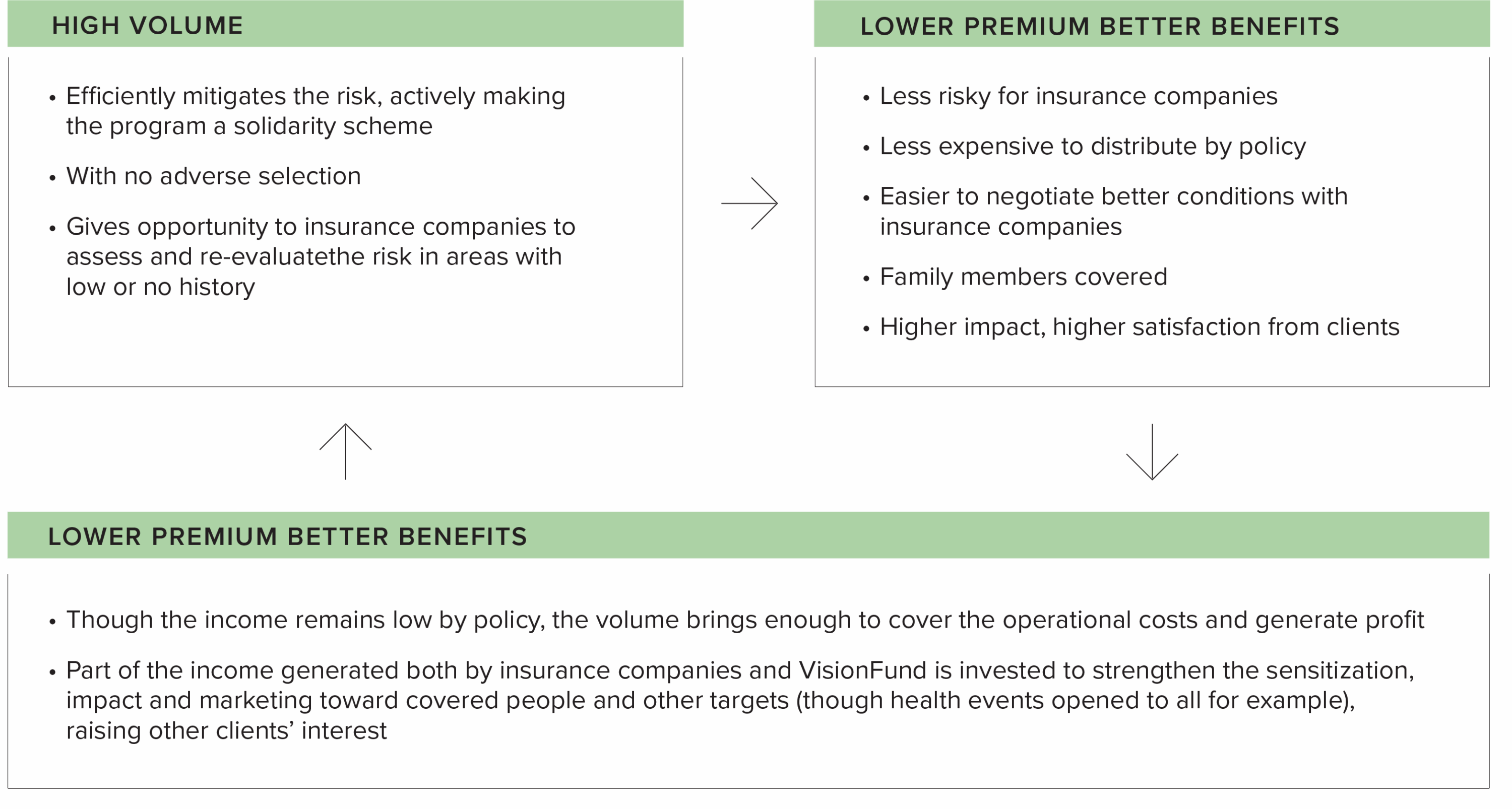
VisionFund learned that to be sustainable, embedded insurance requires careful design. Products must be affordable to keep financial solutions competitive and accessible, while addressing client risks. They must be easy to understand and use, bringing tangible value to clients and the MFI. Transparency and clear communication about the product’s benefits and services are essential to building trust.
After implementation, qualitative surveys assess client satisfaction and understanding. Partner collaboration and monthly monitoring track key metrics such as claims ratios, settlement times and client experiences. Adjustments can be made to benefits, premiums or commission structures if the product is not meeting client needs.
By using its experience to embed insurance into financial products, VFI leveraged a model that creates sustainable safety nets for vulnerable communities while maintaining a balance between client value and programme sustainability.
External data sources
External data are best suited to research questions about broad market characteristics and trends. The availability and quality of external data will vary by market. Some countries have very basic census data, while others carry out annual or even quarterly financial inclusion surveys. Regardless of the depth of data available, external data will give you a broad picture of the market and allow you to be strategic about whom to target with products.
If you began to develop client segments, typologies or personas before this step, external data can help you segment the market and refine ideas around the specific types of people you are targeting. For example, you might decide not to develop a product for rural youth if external data show that youth are moving into urban areas. Or, you might discover that, in the specific geographic area of the country in which you want to launch your product, there are too few women like Erica, and thus the market is too small to ensure a profitable outcome.
External census data
External data sources, such as census data, can tell us how many women like Erica are working in the formal manufacturing sector in a region or city. This can help define the potential market size and determine whether it is worthwhile to pilot a product in that location.

table 2.6. Potential external data sources
| Data | Queries | Use these data to… |
|---|---|---|
| Census data and national financial inclusion surveys | - What is the size of the low-income population?
- Where do they mostly live? - What jobs do they most often have? - Where is access to public utilities or healthcare available, and where is it not? - Where is there access to cellular phone connections? - Where is there access to Wi-Fi? - What are low-income households’ residential buildings made from? - What is the average income of low-income workers? - Where are banks located? - Where are non-bank correspondents and other bank channels located? |
- Consider client segments to target and develop or enrich personas or typologies about these segments
- Identify relevant risks that your product can cover - Spark ideas about the distribution channels that are accessible to your clients. |
| World Bank DataBank | - How many people have bank accounts?
- How many people have mobile phones? |
- Think about distribution channels. |
| Industry publications (i.e., trade association journals, The Landscape of Microinsurance, etc.) | - What insurance products have the highest penetration?
- What are the characteristics of products that sell well? |
- Understand trends in the industry – both to mimic what is successful and to avoid duplicating products that have already secured a large share of the market. |
| One-off research papers (i.e., financial diaries) | - How do low-income households manage unexpected shocks?
- What informal financial tools do households use to cope with unexpected events? - How does cash flow fluctuate in low-income households? |
- Understand what existing mechanisms insurance products need to replace to add value to low-income households
- Understand purchasing power and strategies for payment frequency and collection. |
| News and social media (i.e., articles and commentary about, for example, financing risks, market gaps or market trends) | - What is changing about the market (i.e., is it aging)? | - Think about the products and people on which to concentrate your efforts. |
Using external data – Fasecolda in Colombia
In 2019, Fasecolda, the Colombian Insurance Association, in conjunction with Banca de las Oportunidades and the International Labour Organization (ILO) Impact Insurance Facility, embarked on a project to increase the accessibility and transparency of public data in order to facilitate the development of appropriate coverage for underserved rural populations.
The results included an Excel database organized into four categories based on the ILO Impact Insurance Facility’s PACE Model (Product Access, Cost and Experience) for evaluating the value of an inclusive insurance product. Data from all publicly available sources are grouped and identified for easy access along with examples of insights that can be found in the data. A snapshot of this extensive data set is provided in table 2.7.
table 2.7. Fasecolda’s customer data matrix
| Category
(Product, Access, Cost, Experience) |
Experience |
|---|---|
| Subcategory | Sales Channel |
| What? | Physical coverage of the financial system. Data on territorial coverage of offices and correspondents, coverage density by municipalities and rurality. |
| Source | Banca de las Oportunidades, Financial Inclusion Report with the Colombian Bank and Insurance Superintendency |
| Description | The data and statistics on the territorial presence of the financial system as a whole allow for a global mapping of the areas where there is an infrastructure of financial institutions in which the insurance market can leverage. Additionally, it provides relevant information when evaluating the sales channels to be implemented to serve a new customer segment. These data are an input when defining expansion strategies. |
| Indicators | - Number of branches - Number of Correspondents - Number of Dataphones and ATMs - Density of Coverage with respect to the Population - Density of Coverage with repect to the Terriory - Density of Population Coverage by Region, Rurality and Municipalities |
| Insights | 1.236 (21.45%) municipalities do not have offices, of which 73.7% (174) are rural or dispersed rural municipalities. 2. Although the coverage indicator as a whole has increased (100% of municipalities have atleast one correspondent), not having an office presence in a large number of rural municipalities may limit the supply of available products. Source: Financial Inclusion Report 2020, Banca de las Oportunidades |
| Links | Link 1 Link 2 Link 3 |
| Navigation | In the link download Office Coverage files December 2020 and Correspondent Coverage December 2020. Alternatively, access the Annual Report on Financial Inclusion that includes analysis of coverage based on said data. |
| Frequency | Annual |
| Data Base | Sheet 1 |
Aligning external data with qualitative research for innovative insurance design – Blue Marble in India
Blue Marble, an impact-focused insurtech, provides climate parametric insurance to underserved populations in the Global South.
The product: Parametric insurance against heatwaves
Description: Tailored index-based insurance for women in the waste disposal industry
Coverage: 21,000 women in the pilot scheme.
The Self Employed Women’s Association (SEWA), India’s largest women’s trade union with nearly 3 million members, approached Blue Marble to provide a solution for a highly vulnerable segment: women working as garbage pickers, rubbish collectors and waste recyclers in India’s slums. These workers face significant health and financial risks from extreme heat.
Existing parametric insurance products focused on livestock or agricultural contexts and did not account for this demographic’s unique challenges. Blue Marble sought to address this gap with a tailored index-based insurance product.
Blue Marble partnered with Arsht-Rock, an organization specializing in heat-related health impacts. Through desk research, the team sought to understand the negative effects of heat on the human body, and assessed factors like humidity and day-time and night-time temperatures to identify triggers for the product.
The team also worked with SEWA, who conducted extensive qualitative research using focus group discussions and in-depth interviews with women in the demographic. This helped align scientific findings with real-world experiences of heatwaves to understand the kind of coverage the target population needed.
The resulting product, piloted in 2023, combined these insights to create a parametric microinsurance policy offering income protection during heatwaves. Coverage was triggered when temperatures exceeded a defined threshold for three consecutive days. Claims were designed to be processed in 10-day cycles rather than at the end of the season, ensuring timely financial relief. The project also included the distribution of solar lamps, shade tents and water coolers, providing tangible support against heat and strengthening trust in the product.
Feedback from the 2023 pilot revealed that bundling extreme heat insurance with coverage for other weather events would more holistically address the women’s risks. Blue Marble plans to iterate on the product to include bundled coverage for heat and rainfall.
2.5. Collecting new data – Conducting field research
Since truly inclusive insurance requires a client-centred approach, collecting new data can help you ensure that clients’ voices are heard throughout your process. Every situation is different and access to client voices can be very easy or very difficult to obtain, depending on your organization’s contact and engagement with end users.
When thinking about collecting new data, consider your closest points of contact to your target clients. Do you have a distribution partner with close ties to the community? Do you have active social media platforms that engage your target clients? Maybe your front-line staff know your target market well and can offer some interesting insights, or maybe you have access to others’ front-line staff?
This section can help you think through how to collect data, how to decide on the types of data you want to collect and how to develop the tools that your team will use to collect the data. Alongside the guidance in this section, you will also find several useful resources in the Toolkit.
Remember that once you reach your target market with questions, you need to leverage this point of contact for as many types of information as you can: not only on product needs but also on pricing, marketing, distribution and payment channels, and more. This does not mean you need to have lengthy and time-consuming questionnaires – only that you need to consider your top priority questions from the start, and make sure they are covered in your research.
Using partner insights – Pioneer Life in the Philippines
According to Lorenzo Chan, CEO of Pioneer Inc., distribution partners often offer the best access and insights to clients. He says: “[Early on in our work in inclusive insurance], we realized we needed to learn from and work with our partners and their knowledge of that market segment we were not familiar with.”
With over 80 distribution partners for its microinsurance business, one of the valuable lessons Pioneer learned is that partners need to be proactive and trusted, and have credibility with their clients. Partners can be especially helpful in understanding the gaps clients face, the risk coverage needed and the most appropriate price points, as well as in co-designing affordable products.
“We used to meet with our partners quarterly to review indicators, talk through the customer experience, and look at customer complaints. With over 80 partners today, we are unable to meet as frequently but still make it a point to meet biannually. We cannot afford to lose touch,” Chan says.
Using a participatory approach to gain insights for product design – the R4 Rural Resilience Initiative in Ethiopia
The R4 Rural Resilience Initiative, a partnership between the World Food Programme (WFP) and Oxfam America, aims to improve the resilience and food security of vulnerable rural households facing climate risks.
The product: Index-based insurance for smallholder farmers in Ethiopia
Description: Coverage against climate events for poor smallholder farmers, including an insurance-for-work scheme allowing premiums to be paid through labour
Coverage: Nearly 25,000 farmers by 2014.
R4 designed and developed an innovative insurance product for poor smallholder farmers in Ethiopia. The product uses index-based insurance to transfer risks such as regional droughts. The insurance was designed to complement other R4 strategies, such as savings and microcredit, creating a holistic risk management framework.
The programme introduced an insurance-for-work (IFW) scheme, allowing participants to pay premiums through labour in community drought risk reduction activities. In 2014, a combination of cash and labour payments was introduced, enabling farmers to gradually transition out of the IFW programme.
A crucial aspect of the design process was the inclusion of farmers through the Social Network for Index Insurance Design (SNIID). This participatory approach engaged community leaders and farmers to co-develop the insurance product. Farmers provided input on what risks needed coverage, when payouts should occur and how contracts should be structured. Experimental risk simulation games helped gauge preferences, revealing a strong demand for higher-frequency payouts.
Gender-inclusive design ensured women farmers participated and benefited from the product. Financial education sessions and community-based strategies for managing basis risk were also integral parts of the process.
Through directly involving farmers and engaging local and international stakeholders, the R4 Initiative successfully built trust and an institutional framework for scaling the product. By 2014, the programme insured nearly 25,000 farmers across 82 Ethiopian villages, demonstrating that inclusive design and development processes can empower even the most vulnerable communities.
2.5.1. Quantitative data collection tools
Quantitative data are often collected through surveys, which allow the researcher to ask a large number of people the same questions to reflect market trends. Collecting this kind of data can help you to find out representative information about a group or segment.
In quantitative data collection, closed-ended research questions are best. For example, you might ask which financial products a person owns, how many people they support financially, whether they bank online, or how much money they have in savings. You might provide multiple choice or binary options as potential answers to these questions.
The first step in developing data collection tools is to turn your research questions into data collection questions. Data collection questions can be closed-ended (with specific options or choices) or open-ended (which can be answered in any way that the person being questioned wishes), and these question types are suited to different methodologies: closed-ended questions are more often used in quantitative data collection, while open-ended questions lend themselves to qualitative data collection. Either way, to facilitate analysis, the questions need to be consistent.
The questions should also be phrased simply, using language that is understandable to the respondent (the person who is the subject of the research). By pushing yourself to use simple language, you will be moving one step closer to your future marketing strategy. You will start to test what is “simple” and “easy to understand” for your potential customers. Box 2.5 gives you some examples.
Using simple language when formulating questions
Sometimes we think we sound more informed or professional when we use technical language. However, the danger is that the person listening to us may not understand, and may be too embarrassed to ask clarifying questions. To get the information you need, explaining things clearly is important – and doing this is easier than you think.
First, forget all the training and explanations you have learned about insurance; instead, just describe the terms in your own words. Drop the technical jargon and avoid asking your customers to learn a lot of new terms and conditions. Knowing these specialized words is not essential to their basic understanding of a product or of their financial lives and risks.
Consider some ideas for replacements:
- Insurance = You pay a little every month (day/week/year) and if an unfortunate event happens, it covers part of your loss. If an unfortunate event does not happen, you have paid to cover someone else’s loss, and one day, they may help to pay for yours. It is a protection.
- Premium = Price
- Term = Duration
- Sum assured = Benefit paid
- Mobile/e-wallet = Account on your phone
- Deductible = You pay the first xx amount of the benefit
- Claim = You inform the company of your loss
- Lapse = Your protection ends because you did not pay
- Value-added Services = Additional benefits
- Exclusions = What is not covered
These are just some of the terms you may be trying to explain, but there are many more technical terms about finance and insurance that you can make accessible. Try imagining that you are explaining the ideas to your elderly relative or a young adolescent – that can help you focus on the best words to use.
Box 2.6 considers the sample hypotheses and research questions from the themes in box 2.1 . It illustrates how to turn a hypothesis into a research question, and then how to make these research questions easily understandable for your audience by turning them into data collection questions.
The exercise also explains the methodology that might be best to use to collect the information from your respondents. When you begin to discuss your questions with clients, there is no need to start by saying that you are developing an insurance product. Instead, you should explain you are looking to offer services that will help them manage costly events. If they have a negative image of insurance, mentioning it at the outset might influence their attitudes about your conversation and colour the responses you get.
Remember that data collection takes time and that respondents become tired after they have spent time answering questions. To ensure that you keep your participants’ attention and so get thoughtful and honest answers, a guiding rule is that closed-ended quantitative surveys should take no longer than 15 minutes over the phone or 20 minutes in person. Individual qualitative interviews can take longer, up to 30 minutes, because they are more engaging and conversational. Focus group discussions should be no longer than 75 minutes. Also remember that more data is not always useful; in fact, too much data can make the data analysis process more difficult to navigate.
Turning research questions into data collection questions
1. Awareness
- Hypothesis: Most potential clients in my market have never heard of insurance.
- Research questions: How much of my market is familiar with insurance? Where did those who are familiar learn about it? Why are others unaware?
- Data collection questions: What do you know about insurance? Where did you learn about insurance? Was that a useful and trusted resource for learning?
- Methodology: Client focus groups.
2. Gaps in the market
- Hypothesis: Low-income consumers are having trouble financing funerals and may benefit from a life insurance product that covers funeral expenses.
- Research questions: Do other products on the market already offer funeral insurance? In what other ways do people pay for funerals? How much of a burden do the other financing strategies represent?
- Data collection questions 1: (to investigate through desk research or mystery shopping) Which existing products offer funeral financing? What segment do they serve?
- Data collection questions 2: (for potential clients) Have you had any recent deaths in your family? If yes, what were the exact costs of the funeral (burial, food for guests, flowers, etc.) and how did you pay for each of these? If not, what might you do if you had to pay for a funeral? Was it/would it be difficult to fund a funeral?
- Methodology 1: External data analysis.
- Methodology 2: Client interviews.
3. Demand
- Hypothesis: Hospital insurance will sell very well because hospital stays are so expensive.
- Research questions: How aware of hospital costs are potential clients? How would they pay for a hospital stay now, without insurance?
- Data collection questions: How much money do you think it would cost to spend one night in the hospital? How much money would you lose if you or your family member had to spend a night in the hospital (from lost wages or sales)? How much would you spend on transportation to the hospital if you had a serious illness or accident? Which sources would you use to pay for a five-night stay in the hospital if you had to check in for something tomorrow?
- Methodology: Surveys.
4. Distribution
- Hypothesis: Clients will buy insurance through their mobile carrier.
- Research questions: How much do potential clients trust their mobile carriers? Would they want a higher-touch delivery channel so that they can ask questions?
- Data collection questions: Have you ever bought something using your phone? Would you buy a financial product using your phone? Why or why not?
- Methodology: Client focus groups.
Box 2.7 discusses how to create surveys for inclusive insurance, and the Toolkit contains several other resources to help you author surveys.
Once you have decided on your survey instrument, you need to decide whether the information will be collected on paper or digitally. Paper surveys and questionnaires are more operationally complex, because they need to be printed, numbered, digitized and stored. However, if surveyors do not have access to mobile phones or tablets, paper surveys can be less expensive than digital alternatives.
In the past, digital instruments relied on Wi-Fi or data connectivity on the ground, which could be sparse and unstable. Today, free tools such as KoBoToolbox are designed to work offline with most smartphones, tablets or desktop computers. Digital instruments can be more efficient, because you only need to enter data once, so information does not need to be re-typed. However, you should put in place protocols for uploading and reviewing quality to ensure that surveyors are accurately following the process. Protocols should include rules for how respondents’ data privacy will be secured, aligned with local regulatory privacy norms and regulations.
Designing quantitative survey instruments about inclusive insurance
Survey questions should be closed-ended, allowing respondents to answer questions by selecting one or more answers from a list of options. Always include demographic questions, including income questions, so that you know how to target the appropriate client segments. You can also use surveys to understand the potential of different marketing strategies and delivery channels, by asking about trust and engagement with different potential partners.
Avoid, however, discussing pricing and willingness to pay in any great detail on surveys like this. Since there is as yet no tangible product that clients can assess and assign a fair and affordable price, any discussion of pricing is likely to be too abstract. Refer to the strategy described in the prototype testing section to deal with pricing, once a more concrete offer has been outlined.
The following are suggestions for survey sections, along with a few example questions.
- Insurance awareness. These questions will help you understand how familiar your market is with insurance products.
- Question: Which of the following have you heard of?
- Insurance that covers healthcare or hospitalization
- Insurance that gives my family money if I die
- Insurance that covers crop loss
- I am not familiar with any of these
- Question: Which of the following have you heard of?
- Current financial service utilization. These questions will help you understand how well integrated your market is into the formal financial system. It will also provide ideas for distribution channels.
- Question: Which of the following products do you have?
- Bank account, MFI account or cooperative account
- Membership in a rotating savings and credit association (ROSCA) or village bank
- Insurance (build the survey so the respondent is given options that include the products with which they reported being familiar in the previous section)
- Question: Which of the following products do you have?
- Product demand. These questions give insight into which products a customer might purchase.
- Question: Choose three statements of the following that you are most worried about.
- If I die or my spouse dies, our family will have no support
- I’m worried about getting sick and having high medical costs
- I’m worried about getting sick and missing work
- I’m worried about getting into an accident and having high medical costs
- I’m worried about getting into an accident and missing work
- I’m worried that my home will flood during the rainy season
- I’m worried about something happening to my business, like theft or fire
- Question: Choose three statements of the following that you are most worried about.
Using phone surveys to gain customer insights – MAPFRE Colombia and Bancamía
“First [we] identify what the customer is interested in through our partners at Bancamía. Clients will tell them what products they need” – Diana Angel, financial channel chief, MAPFRE Insurance.
The products:
- Funeral insurance for up to six beneficiaries with coverage nationwide
- Purse theft covering theft of a purse or personal items, as well as disability or death in the case of a robbery.
MAPFRE, an insurance company, and Bancamía, a microfinance bank, partnered to design and develop inclusive insurance products for Bancamía’s clients in Colombia. In their partnership, Bancamía had strong market research capability but limited insurance knowledge. So, to understand the needs of Bancamía’s non-bank correspondent clients, MAPFRE hired a specialized consulting firm to conduct a market study.
The consultants used literature review, analysis of successful experiences in other markets and countries, phone surveys and field visits to suggest the best way to implement a pilot. Since the research took place during the COVID-19 pandemic, the consultants used KoBoToolbox (see more information in the Toolkit) to carry out phone surveys remotely. A sample of the survey topics is included below.
The surveys enabled the teams to understand the needs of their clients. The consultants identified specific risks about which clients were concerned and helped MAPFRE select minimum viable products already available in their product portfolio to test with clients. This allowed the partners to go through a fast three-month iterative and agile process to test and tweak product design, training materials, marketing materials, operations and technology needs without waiting for a full product design process.
Structure of MAPFRE’s phone survey:
- Introduction – One-paragraph explanation of the study you are conducting and the purpose.
- Consent – A consent question to make sure the person wants to answer the survey.
- Knowledge about insurance – Types of questions: have you ever heard about insurance? Do you own any insurance? What types of insurance do you own? Are you satisfied with insurance?
- Demographic information – Keeping the information anonymous, ask about age, gender, etc.
- Risk and coverage – Questions about their workplace, and the risks they are most worried about in their day-to-day life. Some examples: which of these risks do you worry about in your day? (Multiple choice answers). What do you think is the likelihood of any of these happening? Which of these risks do you believe would affect your household income more?
- Coverage and premiums – Questions regarding the amount they would be willing to pay to receive a certain coverage. For example: If you had the opportunity to acquire insurance that would pay X in case risk Y happened, how much would you be willing to pay? (Multiple choice answers starting with the higher price you are trying to prototype; only ask for a lower number if the answer is negative, and introduce lower possibilities until the minimum price that would be viable for the product).
- Client experience with the commercialization channel – Ask if they use the channel you are studying, and how frequently? Do they use the competition? Which channels are the most trustworthy for the client? Ask for opinions about the channel and the personnel working in it. How would you like to receive insurance information? What type of information would you like to receive about insurance? What is your disposable income when visiting the financial channel?
- Thank the client and ask whether the client would be willing to participate in additional research activities.

Using surveys to inform effective product design – VisionFund in Rwanda
“We believe it is essential to understand the community before introducing a new product. Sometimes, we may think we know everything about the community we aim to serve, but the reality is that there is so much information to be gathered through direct engagement” – Damas Filiyedi, Insurance Support Manager for VisionFund International’s African operations.
VisionFund Rwanda began insurance operations in 2017, initially offering products for individual borrowers. To better serve the community, the team set out to understand the unique needs of savings groups: local community collectives often excluded from formal financial services.
In 2021, VisionFund Rwanda conducted a comprehensive survey, engaging with 70 percent of the savings groups in its network. The survey showed that health-related expenses and funeral costs were significant financial burdens.
“This research was pivotal,” explains Filiyedi. “It gave us a clearer understanding of the risks these communities face and their willingness to participate in insurance programmes.”
Armed with the survey data, VisionFund Rwanda partnered with key stakeholders to develop a health and funeral insurance product specifically for savings groups. The product was piloted in a limited number of branches, allowing the organization to refine its approach based on ongoing feedback.
Key insights from the market research and pilot phase included:
- Since many savings group members struggled with premium payments, adjusting the pricing structure ensured accessibility.
- Attitudes toward insurance were influenced by cultural factors, underscoring the need for clear communication and community engagement.
- Feedback highlighted additional needs, such as crop and livestock insurance, suggesting future product opportunities.
VisionFund’s research-driven approach yielded immediate and long-term benefits. Post-launch surveys showed 70 percent of the insured were women, a key demographic in savings groups. The programme also spurred demand for insurance beyond the initial target audience, with individuals outside savings groups expressing interest in coverage.
2.5.2 Qualitative data collection tools
Think about qualitative data collection as a series of guided conversations. These conversations can be individual conversations, conducted through interviews, or group conversations, conducted through focus groups. Research questions best suited to qualitative data collection are exploratory and open-ended. For example, you might ask questions about what financial risks someone faces, what financial anxieties someone has, or how someone prioritizes their expenses.
- Interviews allow you to speak with a single person in great depth and to ask them questions about sensitive topics that might not be appropriate in a group setting. Interviews also enable you to record individual stories, which can be a powerful tool for understanding your market.
- Focus groups allow respondents to engage in conversations with each other (guided by your data collection questions). Focus groups are a useful format for listing and ranking client needs and preferences, since participants can work together to agree on lists and ranks that resonate with them as a group. They are also the best medium for customer journey mapping, and for gaining insight into how a market segment discusses its needs and preferences – your team will want to mirror this language in marketing materials.
- It is important to conduct focus groups with each client segment separately, both to learn as much as possible about that segment and to create a comfortable environment for participants. For example, having Erica and her fellow garment workers in one group would allow you to gather more information about how they are paid, the financial instruments they use, and their hopes and dreams for the future. This can help you consider which assets female garment workers are most interested in protecting. Box 2.8 provides guidance on conducting focus groups.
- Mystery shopping is typically seen as supply-side research, enabling you to find out what your competitors are offering, as well as how and through which channels they are offering it. Mystery shopping can also provide a more nuanced understanding of customers’ experience during the sales process. When you or your team put yourselves in the customers’ shoes, you can feel whether customers are being treated respectfully, observe whether customers are receiving consistent and clear messages about the product and find out how staff respond to questions. The Consultative Group to Assist the Poor (CGAP) offers a Guide to Mystery Shopping for financial services that can help orient your team on this path.
Most qualitative analysis involves small samples, because it does not seek to be representative. This means data can be analysed using spreadsheet software such as Microsoft Excel or any simple matrix format. Specialized software is also available for larger and more complex data sets. This kind of software can also be useful when organizational capacity for sophisticated analysis is low. Our Toolkit offers resources that can help.
Focus groups with potential clients
Starting the focus group: Introduce the group to what you are doing and make it clear that you are trying to learn from the group – there are no right or wrong answers. If speaking with a delivery channel or internal staff, emphasize that their performance is not being validated in any way.
Questions: The ideal focus group question is one that will inspire a discussion. There should be 3–4 broad questions, and each question you ask should be associated with some additional “probing” questions, which can be more narrow. These probing questions are follow-up questions that can help to move a discussion along if it is stalled. Here is some guidance on focus group questions for inclusive insurance:
- Start with a warm-up question, such as “Tell us about your work, business or household”, depending on who the participants are. If your participants are connected to you through a work-related relationship (microfinance institution, merchant group, etc.), ask work questions. If you know them through a family-related relationship (school, church, etc.), ask family questions.
- Organize your questions around three topics: risk, financing and trust/distribution. Some suggestions for questions and probes for these categories are below.
- Risk: “What do you worry about?”
Probe for risk types such as health emergencies, deaths, accidents and disasters. Listen to the language used to describe these risks and fears. They can help you design marketing language. - Financing burden: “What events would be most difficult for you to pay for?”
Probe for the risk types that were mentioned in the previous question, specifying which are most costly and difficult to pay for. Consider ranking these from difficult to easy to pay for and from likely to unlikely and then creating a preferential ranking of insurable risks. - Trust/distribution: “If an insurance product existed that could help you pay for the consequences of the risks that we discussed, who would you trust to buy it from?”
Probe for distribution channels like insurance agent, bank, MFI or mobile operator.
- Risk: “What do you worry about?”
Final tips: Focus groups for inclusive insurance tend to be centred around ranking activities (for example, the most relevant risk, the most expensive risk or the most desirable distribution channel). It can be helpful to write these down on a board that everyone can see and ask the group to rank them together. This gives you a group consensus and also allows you to hear the group’s thoughts about the issues, which can be very helpful in product development and marketing. Listen for specific language used to describe these things to make sure that when you design marketing strategies, the language is simple and accessible.
Understanding barriers to customer demand – AXA Mandiri, Indonesia
Table 2.8 shows some of the insights collected through qualitative focus groups with clients with AXA Mandiri in Indonesia. Insights were sorted according to four themes or dimensions (trust, understanding, unpredictable cash flows and family decisions) to gain a richer understanding of how clients make purchasing decisions. This allowed the researchers to better understand how explaining products clearly to customers could build trust, and to see that these explanations alone were not sufficient. Product simplicity and one-time payments were also critical to avoiding misunderstandings and late payments.
By discussing family relationships and dynamics, the researchers identified the difficulties in marketing products to women. Men had strong opinions about their wives’ purchasing decisions and were often a barrier to purchasing insurance. Mandatory products linked to women’s existing product consumption or family, for example, avoided this problem.
table 2.8. Demand side barriers identified through focus group discussions
| Trust | “I trust the insurance [card] because we are inside the bank [branch]”
– Formal employed woman
“Once I had insurance … when I could not pay the premium, it stopped [and I lost everything]. I realized it was my mistake, but I never trust insurance” – Formal employed woman “Insurance agents hike the prices up in order to make more money” – Retail bank customer |
| Understanding | “I had AXA insurance, but when I went to use it I learned that the system was reimbursement. I was shocked”
– Female Mandiri retail customer
“Most people understand insurance here in Tangerang, but not in the villages” – Female microloan customer |
| Unpredictable cash flows | “I had health insurance, but I stopped paying the premiums. I needed the money for something else” – Female microloan client |
| Family decisions | “My wife would not buy [insurance], she already has credit and that is too many expenses”
– Formal employed man
“I can’t buy anything without talking to my husband first” – Female microloan client |
Right-sizing benefits through customer engagement – Turaco in Ghana
Turaco provides affordable, mass-market insurance products across the Global South. Leveraging partnerships with fintechs and traditional financial institutions, Turaco has insured over 5 million people in Ghana, Kenya, Uganda and Nigeria. Its primary focus is on life and health insurance, distributed digitally to underserved populations.
In Ghana, as competition has increased in the insurance market, insurers have tried to differentiate their products by adding extra benefits, which has sometimes meant extra costs for consumers. However, many customers neither understood the extra benefits nor found them useful.
To better understand the needs of its target customers, Turaco conducted focus groups with representatives from existing client segments. Based on the responses, the company identified that some client segments were particularly interested in specific risks like maternity care and post-natal care, for example.
Using this customer research, Turaco developed a simplified health insurance product for low-income women. By unbundling benefits from traditional health insurance plans, Turaco created a more affordable option. This simplicity and affordability, in turn, allowed Turaco to distribute the product digitally through broad partnerships with local financial institutions, thus reducing adverse selection.
To ensure that customers are well served and truly understand the product, Turaco directly offers SMS and call centre support to clients.
Early feedback indicated strong customer interest and appreciation for the simplicity and affordability of the product. Turaco plans to regularly refine and scale the product based on customer feedback and market demand.
2.5.3. Sampling and recruitment strategies
Your research sample is made up of the people whom you will survey, interview or speak with in a focus group. Ensuring that you choose the right people for your research is as important as designing your research tools. They have to be comfortable speaking to you and not be worried that their jobs, loans or commercial relationships might be affected by what they say. It is important to invite people as randomly as possible to avoid only selecting those who are most engaged and outspoken.
You also need to ensure that when people are speaking to you, they are in a space that feels safe and private. In practice, this may be difficult. Some people from your segments might live very far away and lack access to transportation to reach you. Some people may be uncomfortable participating. To ensure you hear from a broad range of people, you might consider having a trusted person or institution invite respondents, you may need to travel to respondents’ communities, and you might offer participants a small incentive.
To begin, think about the kinds of people you want to have in your research sample. If you have started to create segments before this step, you can use them to determine the right people to speak to, as well as to ensure that you interview enough members of each segment or typology. If you have a large pool of clients to draw from and they represent the market well, you can focus on recruiting your clients for the research. If you have identified client segments that are not represented in your client base, you will want to include outside respondents. For example, if your market includes a high frequency of college-educated, single women, but you currently have no products that serve this segment, you may want to make a connection with a local university to recruit female alumni.
Respondent recruiting strategies
While many good resources exist to help you find the best way to reach participants (see the Toolkit), you may want to be a little more strategic about the people you sample when doing research for inclusive insurance. Here are some ideas for how to sample effectively.
- Go where potential clients are. If you are hypothesizing a need for a product for small business owners, go to the locations where the kind of businesses that you want to target are and ask people if you can talk to them during their downtime.
- Take advantage of community organizations. If you want to speak with smallholder farmers, get in touch with a cooperative or a community savings and loan organization for farmers, and find out if you can attend one of their meetings.
- Ask respondents if they can refer you to friends. This strategy is called snowball sampling and it is a great way to increase your sample of a specific segment.
- Talk to current clients. Since they are already engaged with your company, they can be an excellent resource.
- Talk to sales agents and distribution channels. The staff who work directly with clients will have important insights to share. Also, you need to understand potential distribution channels to design and distribute your product.
- Offer incentives such as transport reimbursement, refreshments or even cash to make sure everyone attends. Check with your distribution channel first to make sure you align with their incentive policy.
Another important decision is defining the number of people to whom you will speak. This is your sample size. Different methodologies require different sample sizes and determining a sample size may be partially dictated by your capacity to reach people and by your budget.
When sampling respondents for qualitative data, you should aim for 13–20 respondents per segment. After about 10 respondents, you begin to see patterns you can analyse in preferences and behaviours. For focus groups, two groups of 6–8 people per segment are better than one large group. This way, a group dynamic that goes awry can be mended by a second, similar population and findings can be validated between groups. Qualitative data is not statistically significant or representative. You are just looking to discuss the answers to the questions “why?” and “how?” and to understand them across different experiences.
Selecting the right sample size is a critical step in quantitative data gathering. Tools like SurveyMonkey and Creative Research Systems offer guided processes for determining sample sizes, and generative artificial intelligence (AI) tools, such as ChatGPT, Claude, Copilot or Deepseek, can also help with this process if you provide specific inputs (see box 2.10 for an example). Inputs might include the total size of your population or market, your hypotheses about the differences you expect to observe between groups or segments, the desired confidence level for your results, and the acceptable margin of error. For instance, a 95 percent confidence level and a margin of error of ±5 percent are standard parameters in many studies.
Input for using AI tools to help select sample size
To use a generative AI tool (such as ChatGPT or Deepseek) for sample size guidance, you can input the following:
- Total population size: (e.g., 10,000).
- Expected differences: (e.g., “I expect a 10% difference between groups A and B”).
- Confidence level: (e.g., “I want 95% confidence”).
- Margin of error: (e.g., “I need ±5% precision”).
Example input: “I am conducting a survey on a population of 10,000 people. I expect a 10% difference between two groups and need a 95% confidence level with a ±5% margin of error. Can you help me determine the required sample size?”
The AI tool will then calculate or guide you through determining the appropriate sample size based on your inputs.
If your goal is to assess statistical significance, you will need to account for statistical power in your sample size calculations. Statistical power ensures you have a high probability of detecting meaningful differences in your data, typically set at 80 percent or higher. Many online sample size calculators automatically include this consideration.
However, if your focus is on exploratory research to gain insights or describe your market, and you are constrained by time or budget, statistical power may not be your priority. In these cases, a practical guideline is to aim for at least 200 total survey responses, with about 60 responses per segment for meaningful subgroup analysis. Of course, more is always better, but less is workable too – just try to get as many respondents as you can! Finally, if you are conducting an academic survey, you will likely want to work with an academic researcher or institution.
2.5.4. Best practices: Respecting participants and data protection
Whether you are speaking with your clients or with other members of the population, be mindful of some important principles in collecting this type of data, as outlined in box 2.11.
Ethical principles when collecting data from individuals participating in your research
- Gain the informed consent of all participants by explaining the goals of your research as well as who will have access to the information that they share. Participating in data collection must be voluntary, and respondents should be allowed to decline to answer any specific questions and to stop participating at any time.
- Anonymize the data in any meetings or publications, even internally. Any opinions, stories or quotes that a person shares with you should not be repeated alongside their name. Instead, you can share their story with anonymous descriptors, such as their age, location and job. Ensure that these descriptors are not specific enough for someone to be able to identify the person. Consider giving participants identifying numbers and storing their names and numbers in a separate file from the data. Store all data in a secure way.
- Compensate participants for participating in your research. Not only will this help encourage people to participate, but it will also demonstrate your respect for their time and opinions.
2.5.5. Planning fieldwork for data collection
When your data collection instruments and sample recruitment plans have been finalized, your team will need to finalize a data collection plan. Along with the guidance in this section, the Toolkit contains resources for managing data collection, including tools that can be used to ensure gender inclusivity is considered throughout this process.
Data collection includes managing the fieldwork, including the recruitment, training and supervision of the people conducting the data collection, as well as managing the data that are collected to ensure they are complete and well organized. Fieldworkers perform the researcher tasks of surveying, interviewing and facilitating focus groups. Make sure that your fieldworkers are experienced with the target population, and ideally ensure a gender balance to enable people of all genders to speak more freely and comfortably.
Regardless of who is doing the fieldwork (whether it is surveyors from a survey firm, loan officers from a distribution partner, etc.), training should be provided to ensure that questions are asked in the same way and with the same intention to all respondents. This is an important part of the research process that can be easy to let slide, but without providing formal training, you risk wasting time, funds and energy collecting data that do not adequately answer your research questions. Box 2.12 provides tips on recruiting, training and compensating surveyors, interviewers and focus group facilitators.
Training should include a session on how to ensure that you are respectful and inclusive of all types of respondents. This includes women, youth, the elderly and people with disabilities. It might be helpful to have a discussion to explore the biases that fieldworkers may have when recruiting and talking to respondents, to ensure that they are aware of the need to be as inclusive as possible. Fieldworkers may come from different socioeconomic groups or age groups and may not be sensitive to the types of constraints older or more vulnerable respondents face. Fieldworkers should also be instructed to be gender inclusive, highlighting that in some cultures and contexts, women may prefer to be interviewed separately from men. In other contexts, women may need to be spoken to with more caution, since they may have reservations about revealing personal information. Consider the perspective of your more vulnerable respondents and ensure they are reflected in your approach.
You will also need to make sure you have a plan for quality checks. Checking surveyors, for example, could involve calling a few random respondents and ensuring that they spoke with the surveyor, or it could include analysing data for outliers or patterns among surveyors that might indicate they are making up (fake) data. To quality check interviews and focus groups, you might listen to parts from a few recordings.
Unless you are outsourcing all of the fieldwork to a market research firm that has protocols in place, you will want to think about how to best compensate and incentivize fieldworkers. Consider paying a small daily rate for “showing up”, alongside a fee per completed survey for surveyors (and make sure these are reviewed before payment), or for interviewers and facilitators, a fee per completed interview/focus group and relevant notes. Reimburse fieldworkers for transportation and airtime as well as any other work-related expenses.
Data collection involves determining the form in which you want the data. For surveys, this might mean a plan for downloading data from mobile devices, or a programme for data entry when paper surveys are being used. For interviews and focus groups, you will need to think about the requirements of your analysis plan. Do you want interviews and focus groups recorded? Do you want interviewers and facilitators to take notes? Would it be useful to have recordings transcribed (written down word for word)? Are you comfortable using AI tools for any of these functions and if so, what privacy protocols should you follow?

Tips for recruiting, training and paying your surveyors, interviewers or facilitators
Training sessions should be held to ensure that that data collection questions are asked in the same way and with the same intention to all respondents. A template for a training session is below.
1. Sensitization (roughly 1 hour):
- Begin the training session by asking one or two trainees about their own experiences, or those of friends and family, with unexpected financial shocks. Ask recruits to explain the financial measures they took to deal with the problem.
- Introduce the concept of insurance and explain the purpose of the research.
- Ask if anyone has had bad experiences with insurance and discuss the importance of not introducing their personal experiences into the research process.
- Engage in a discussion of biases towards people and how to remove these prejudices from data collection.
2. Review of instrument (roughly 2 hours):
- Go around the room and have the trainees take turns reading sections of the instrument. After each section, explain the meaning and purpose of the question as well as exactly how you want them to ask the question. Allow trainees to ask questions before moving on.
3. Break (30 minutes)
4.Technology or note taking
- If performing a survey, introduce the trainees to the survey app and its features.
- If performing a focus group, discuss plans for transcripts or note taking. For example, if recording and asking the interviewers to transcribe the interview, explain exactly what the final product should look like (i.e., an exact transcription of the interview or notes on the responses). If training note takers for focus groups, discuss what is important for them to write down and what to listen for.
5. Practice (Remainder of day):
- Divide trainees into pairs and have them practise on each other.
- Share experiences and tips from practice with the entire group.
2.6. Customer journey mapping
Customer journey mapping is a qualitative tool that relies on understanding and empathizing with the client around their entire experience with a product. It can provide the key to discovering frictions in the customer journey as clients learn about how to acquire, pay for and make claims on an insurance product. This can improve the customer experience and ensure greater acquisition, payment compliance and claims.
Remember that inclusive insurance needs to offer value for end customers, so it is essential that customers understand products and make claims when they are due. That means that processes need to be clear and simple, with as little friction as possible. The customer journey map can help identify which products, services, actions and interactions or touchpoints will lead to a smooth customer experience.
You can map your customer journey by individually interviewing a sample of clients about their experiences, or by conducting focus group discussions. Before you begin, it is a good idea to capture in which segment each participant belongs, since different types of clients may have very different perceptions and experiences, giving them very dissimilar journeys. You can reference the qualitative data collection section to learn more about preparing for and running client interviews and focus groups.
Box 2.13 discusses how to lead an individual or group in a customer journey mapping exercise. Customer journey mapping can also be conducted during design workshops to map out the process that your institution would ideally imagine for a client.
Customer journey mapping (example of products currently in the market)
Customer journey maps can be used to understand how a client learns about a product and the client’s experience with the product. With this information, a service provider can generate client-centric recommendations for product development, process improvement and customer satisfaction improvement. Customer journey maps can also be used in the product design phase when developing new products.
Follow these steps to construct a customer journey map for current clients:
What you need: This exercise works best as an interactive focus group activity, though it can be done with individuals as well. You will need something to draw on that is big enough for the group to see, and a few different coloured pens.
Step 1.
Identify the objective for the map. You may want to focus on the customer’s journey when purchasing your product, when paying premiums or when filing a claim for the product. Or you may want to look at the entire journey from start to finish. For this example, we will focus on purchasing the product.
Step 2.
Next, design the map. Ask respondents to tell you the steps they took in their journey. Start by asking how they first heard about the product, and then ask what happened next. Customers may have unique processes. Identify the steps in the process from the client’s perspective and create a column for each step. For example: Discover, Consider, Enrol, Pay and Confirm.
Step 3.
Once you have written these down and agreed on the steps with clients, add rows that represent actions, touchpoints, thoughts, emotions and areas of improvement. Go back through each step and ask your clients questions about each of these. Write the answers for each in the column under the step. For example, “What were you thinking at this step?”, “How did it make you feel?” or “How could this step have been improved?”
Step 4.
Finally, analyse the data. This might lead, for example, to insights such as that the customers would have benefited from product materials, or that the distribution channel (for example, the bank branch) is creating significant friction in the process.
2.7. Analysing your data
Most projects suffer not from too little data, but from too much data. Keeping your data collection tools short and to the point will reduce the complexity of data analysis and make it more effective. To be as efficient as possible, think about your analysis plan before you create your data collection tools. Remember that your analysis needs to be unbiased, and that it needs to consider the results of the research rather than your initial hypotheses and opinions.
Analysis of qualitative interviews should focus on how respondents (by segment) manage risks and their perceptions of the difficulties of their risk management tools as well as of the likelihood of the events that pose risk. Analysis should also assess which delivery channels are most trusted.
You might find qualitative software programs such as Dedoose or Nvivo helpful in analysing your data. This kind of software is particularly useful if you have large sets of data or if you do not have analytical personnel available to work on the study. You can also use a spreadsheet table, using Microsoft Excel or another spreadsheet application, with questions as the column headings and respondents as the rows. This can enable you to compare responses across individuals and identify patterns. Remember to make note of the demographic characteristics of respondents to ensure that your analysis includes segmentation. Focus group analysis can also be grouped in tables, with one row for each group.
Finally, generative AI tools can support you in the process of data analysis. You can start by preparing your transcripts to ensure they are clear and organized, removing unnecessary filler words while preserving the original meaning. Then, you can provide an AI tool such as ChatGPT with some brief context for the project, such as explaining that the focus group discussed barriers to accessing inclusive insurance. Then, share a portion of the transcript and ask for specific insights, such as identifying common themes, highlighting challenges, extracting key quotes or summarizing participants’ recommendations. For example, you might say, “This is a transcript from a focus group on inclusive insurance. Please identify the main themes and barriers discussed and highlight any suggestions or participant quotes about improving access.” The AI tool will analyse the text and return a summary or analysis, which you can refine further by asking follow-up questions tailored to your specific focus.
This process can help you quickly uncover meaningful insights to guide your work. However, be aware that it is not a perfect solution. Part of the “magic” in analysing voices from clients is in understanding nuances that transcripts may miss. Consider people’s body language, moods and tones during discussions. Were they relaxed? Did they fully understand the topic? Did they suggest that some of their verbal responses were too optimistic, perhaps to please you or a partner organization? It is important to make sure that technology is your helper and not a crutch.
Using AI tools to support qualitative data analysis
If you are using an AI tool to support your analysis of your focus group transcripts and notes, consider this prompt when attaching the transcript or a portion of it:
“This is a transcript from a focus group where participants discussed their experiences with inclusive insurance. Please identify the main themes and challenges they mentioned. Also, highlight any specific suggestions or quotes about how insurance providers can better serve low-income populations. Here is [a portion of] the transcript: [Insert transcript].”
Analysis of quantitative data should begin with thorough data cleaning. Before you begin, go through your data and “clean” them. First, eliminate duplicate and blank entries. After this, consider coding some open-ended answers or adjusting any inconsistencies: for example, if the answer to a question is “3”, and the responses are written as “3”, “three” and “III”, these should all be recoded to “3”. The analysis can be conducted in a statistical software package or in a spreadsheet application such as Microsoft Excel, depending on internal capacity.
You can learn a lot from survey data without doing anything sophisticated. Begin with basic descriptive tables that show who was interviewed (gender, age, occupation, income, etc.), as well as tables of survey responses to each question, giving frequencies and averages depending on the questions. If you want to know how many people answered that they have a loan, you can show the frequency of this response (e.g., 40 percent). If you want to know how often people see a doctor, you may want to show an average (mean) and standard deviations if you have a large data set. You can then make tables of the results by segment to explore the risks, preferences and financial constraints specific to each segment.

Checklist: Market research
Did the team…